



Nick Ray’s Cat IV Record F1R
Nick Ray’s Cat IV Record F1R

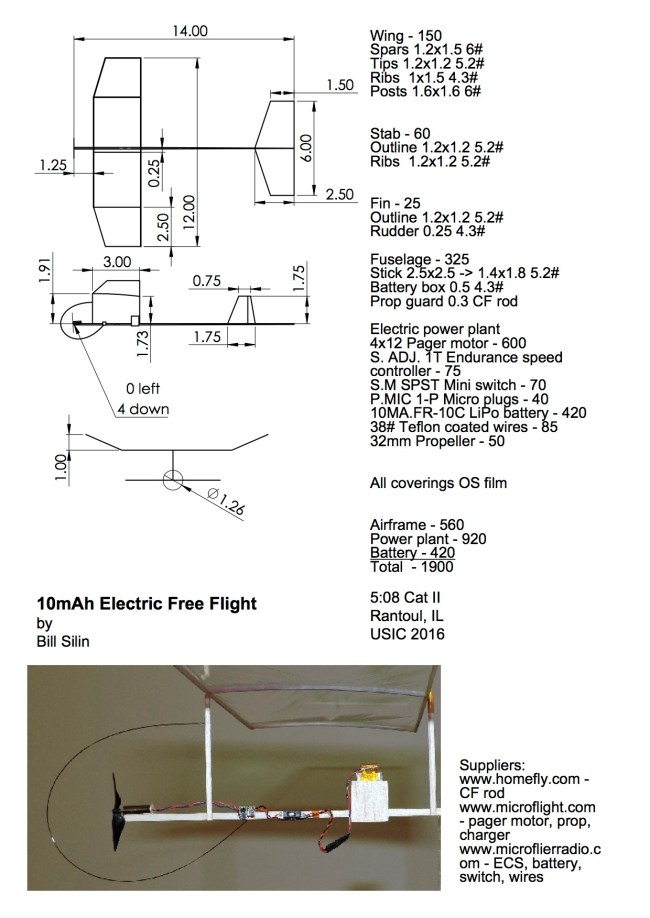
Click here to download a PDF of the plan.

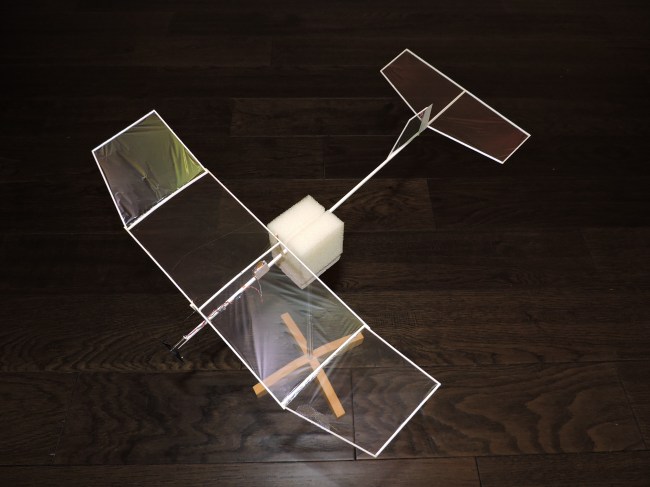
F1R – Photo taken prior to hang up and recovery
Setting indoor duration records always comes with a series of challenges. My most recent F1R record came after a hang-up on one of the Kibbie Dome “clouds” and possibly one of the worse recoveries I have made in recent memory. After all the usual tricks had failed, I decided to try dangling Scotch tape off of the wooden retrieval rig I had attached to a mylar balloon. I caught wing tip, and as the torque from the motor spun the model around the prop also stuck to the tape.
Once I got the model down, I had a ball of balsa and film, and more Scotch tape than I knew what to do with. Somewhere in the process of separating the pieces with solvent Chris Borland came by and snapped a picture.

F1R remains after retrieval (Photo by Chris Borland)
I an hour later, I returned to my table with all the pieces and set to work repairing the model. Jake Palmer helped by giving me some patching material and by the late afternoon I was ready to fly again. I switched to a larger diameter prop, and retrimmed the model. After a few test flights I was ready to resume making my contest flights. The flight was largely uneventful, reaching an altitude of 37 yards, and only required a brief steer before landing to avoid getting caught on the goal posts.
I would like to dedicate this record to my long time friend Bill Clark. He often took me to contests when I was a kid and firmly believed than any problem could be fixed with epoxy and duct tape. In this case it was Scotch tape and Ambroid, but I think he would agree that it’s close enough.
~Nick Ray


A New Wood Cutter – Krucoun Krucky
A New Wood Cutter – Krucoun Krucky
Krucoun Krucky of the Czech Republic has started cutting high quality indoor balsa. He provided three sheets for me to review at the 2016 F1D world Championships. I chose three sheets at random out of a stack of more than 100 sheets. Each of the three sheets was a bit over 20 inches long. Thus, they are an ideal length for making two F1D motor stick blanks out of one sheet.
Generally when reviewing wood we consider the packing and grading of the wood, but neither are applicable in this case. Since I took possession of the sheets directly from the stack, I cannot comment on how the sheets would be packed for shipping. Furthermore, the sheets are ungraded, as such, no commentary can be offered on accuracy of the grading.

Sheets 1 – 3 (from top to bottom) laid out on a table
Sheets 1 and 2 are relatively straight along the length of the sheet, however sheet 3 curved with the center rising 0.25 inches above the ends when paced against a straight edge.

Surface finish of sheet 1
The surface of the sheet is smooth and there are no visible saw marks.

The above chart shows the thickness of the sheet in thousands of an inch. Samples were taken at the edges and center of the sheet at two inch intervals. The density was calculated using the average thickness of the sheet.
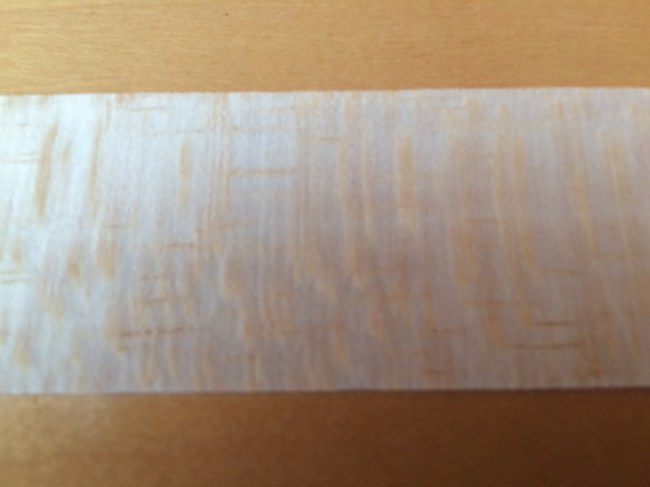
Surface view of sheet 2
The surface of the sheet is smooth and there are no visible saw marks.

The above chart shows the thickness of the sheet in thousands of an inch. Samples were taken at the edges and center of the sheet at two inch intervals. The density was calculated using the average thickness of the sheet.

Surface finish of sheet 3
The surface is relatively smooth, but there are some visible saw marks in the top left of the photo. The marks are more visible when viewing the sheet in person.
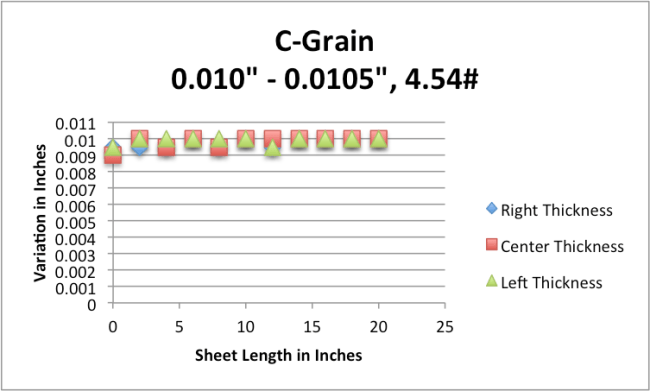
The above chart shows the thickness of the sheet in thousands of an inch. Samples were taken at the edges and center of the sheet at two inch intervals. The density was calculated using the average thickness of the sheet.
Krucoun Krucky is offering sheets for $5 plus postage. I would like to thank him for the opportunity to review the sample sheets.
Nick Ray ~ 7.16


Manuel Angel Diaz’s F1R
Manuel Angel Diaz’s F1R
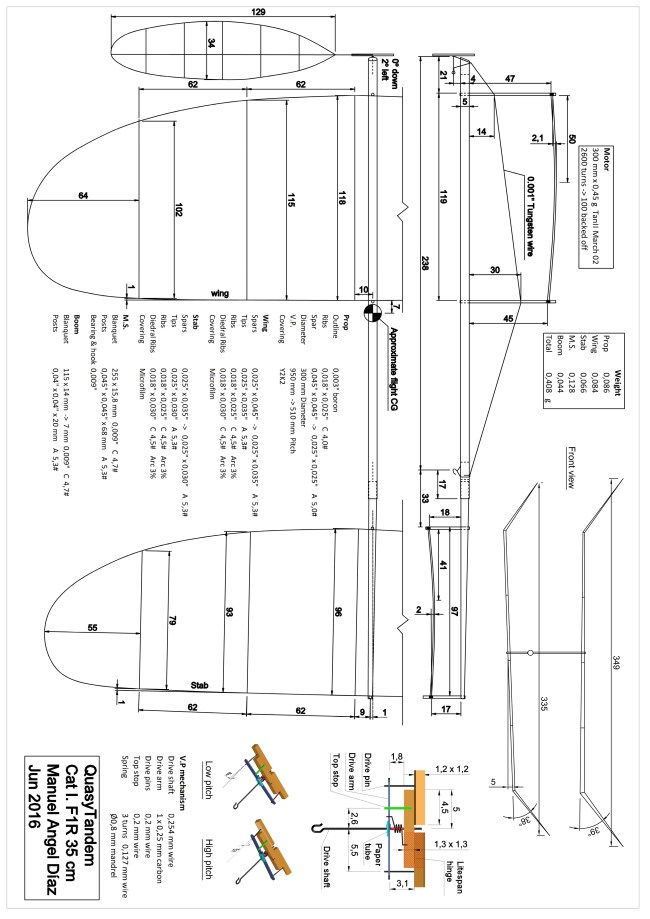
Click here to download a PDF of the plan.
Since the first flight test, the behavior of QuasyTamdem has been very good. Under an 8m roof the plane is able to do 17 min without any problems. With some adjustments, the time can be increased significantly.
In general model is very robust, and the behavior in the early flight is suitable despite the high torque of the rubber in these early stages. I chose the microfilm coating in order to save some weight in the covering and to increase wood sections in order to gain in stiffness.
The coating of the propeller, on the contrary, is Y2K2. This makes it a bit more robust in order to avoid damage when it touches the ground for example.
The rubber torque remains high enough throughout the flight which, combined with propeller pitch change, makes the model maintain a smooth flight pattern throughout the flight. The model climbs gently up to the ceiling, and comes down on the last winds of the motor. The motor-stick allows for larger rubber sizes, which would probably increase the flight times.
The V.P. mechanism has the spars on the front. This system is the one I like because although the length of the drive pins are greater, the carbon drive arm is closer to the hub of the propeller. Therefore the top stop arm is shorter. Besides the longer arms, the carbon driver arm and pins makes the mechanism more “manageable.” Therefore, it is easier to handle and adjust the mechanism. Furthermore, small clearances between elements are necessary for more accurate operation of the mechanism.
A combination that includes a larger section of rubber, accompanied by an adjustment in the variable pitch mechanism to reduce the rate of climb, will probably increase flight times.
~ Manuel Angel 6.17.2016

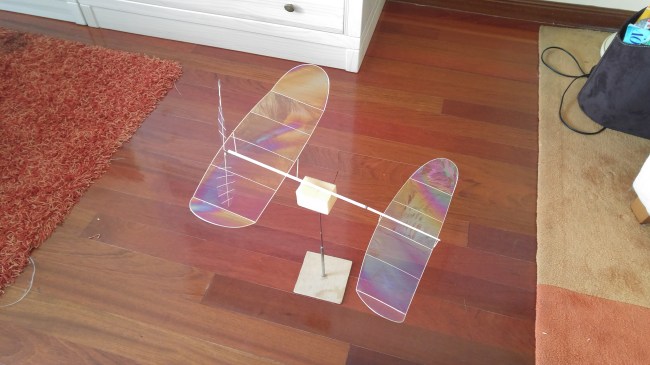
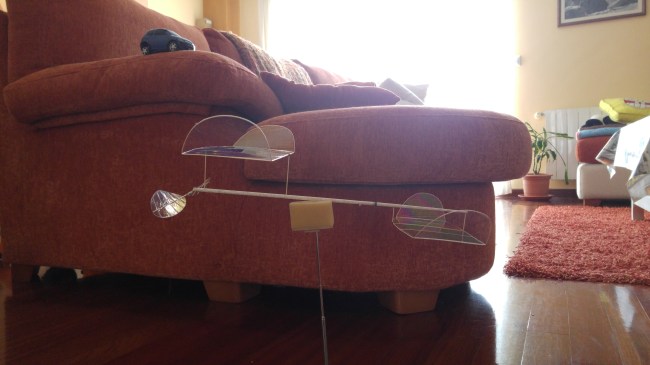
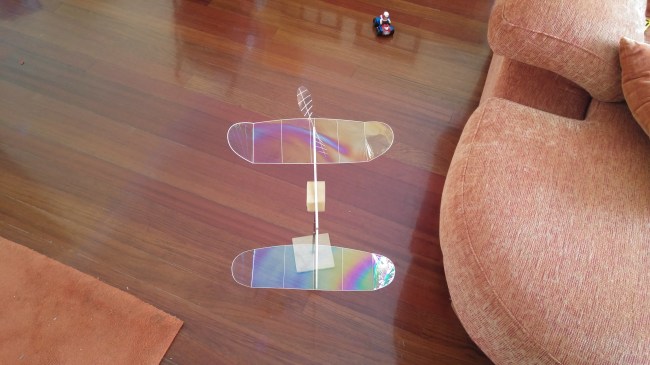


Yuan Kang Lee’s World Championship F1D
Yuan Kang Lee’s World Championship F1D

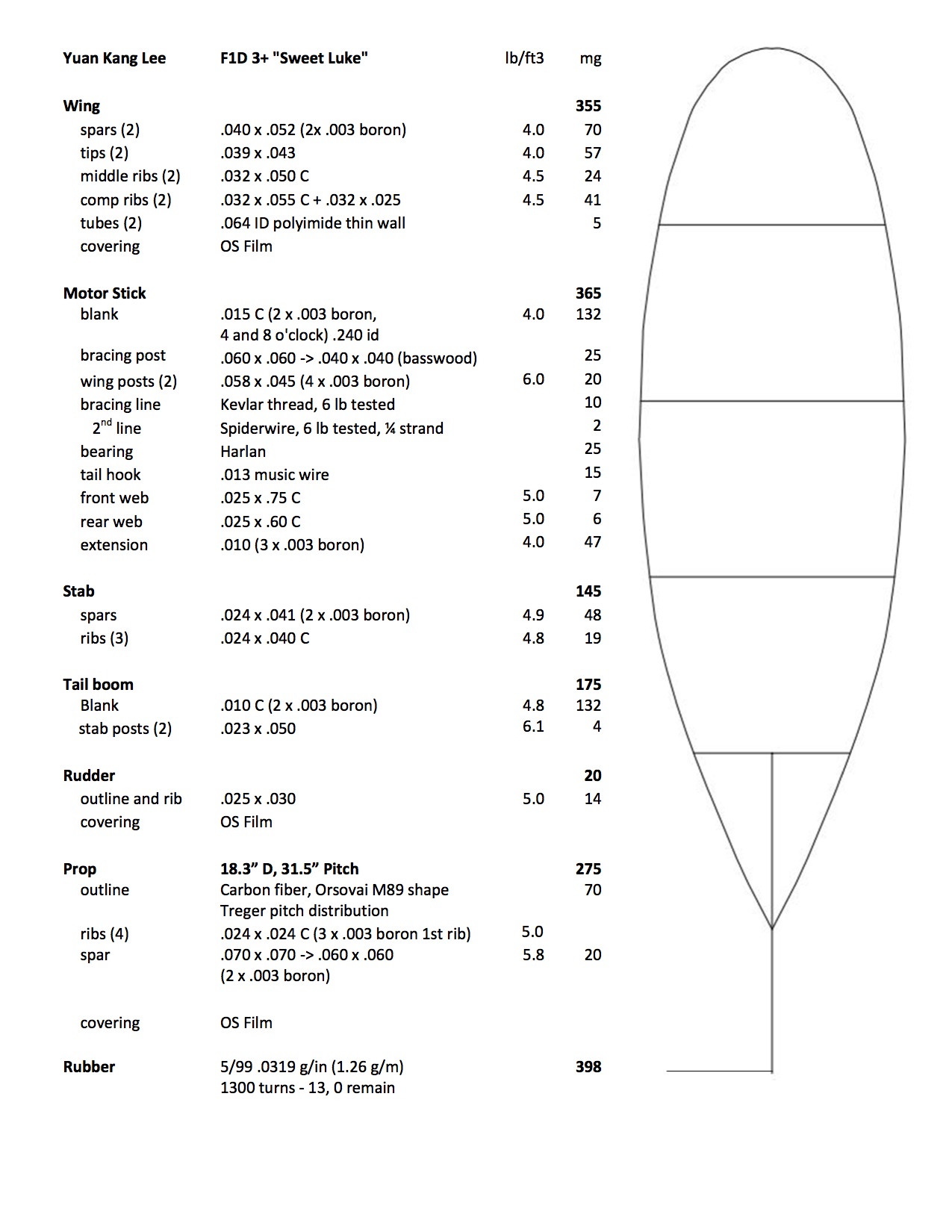 Click here to download a PDF of the plan.

View more by category: Uncategorized (292). .
 Indoor News and Views