
Nick Ray’s Ministick
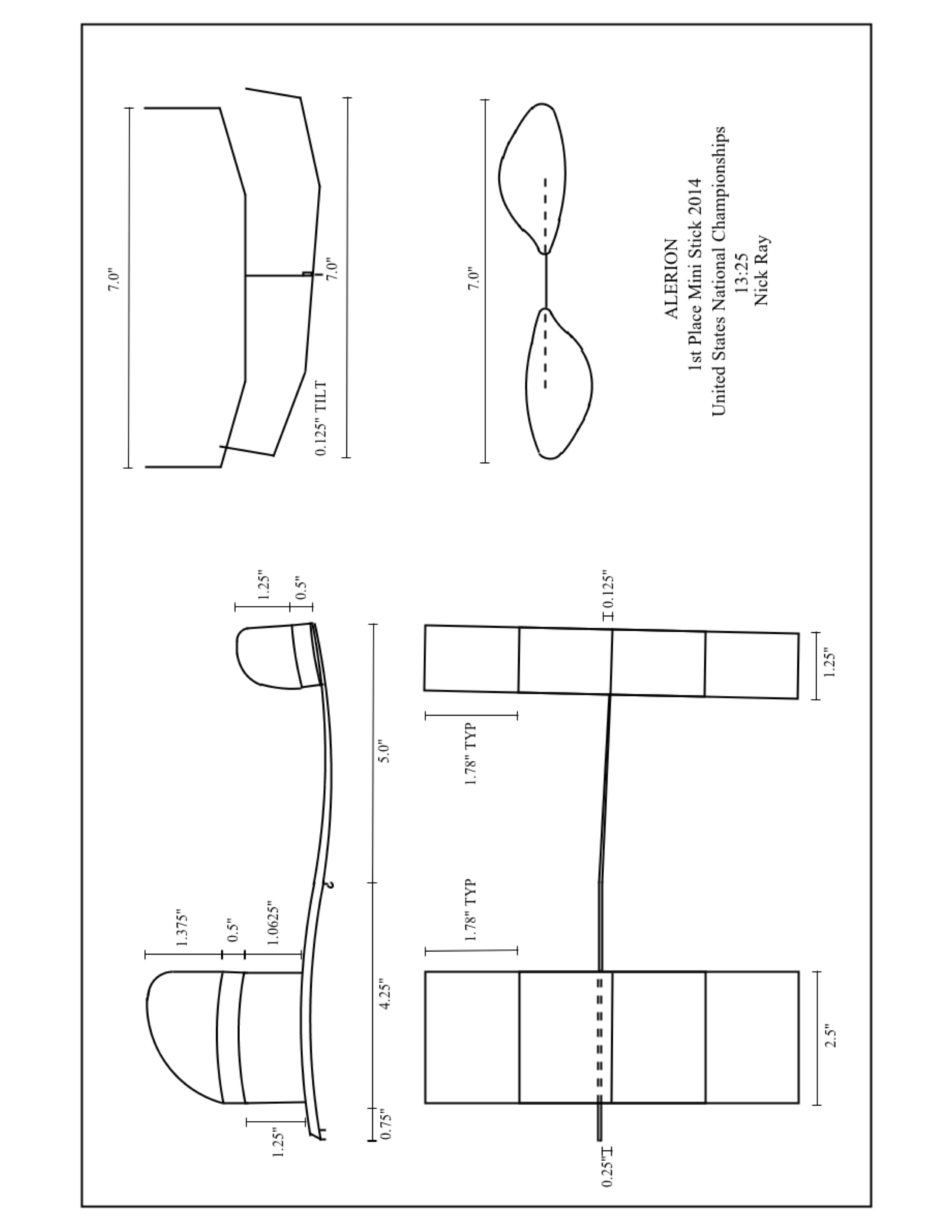
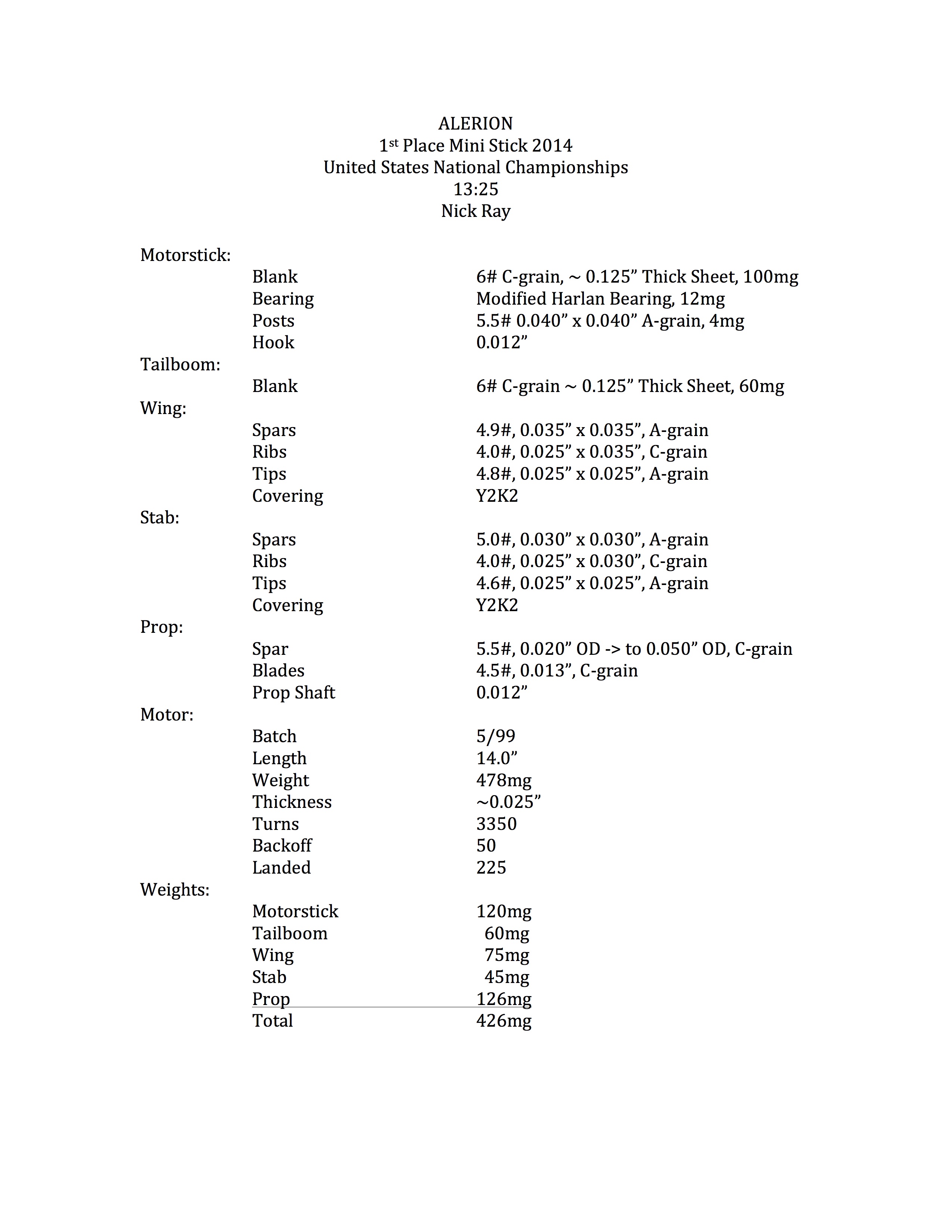
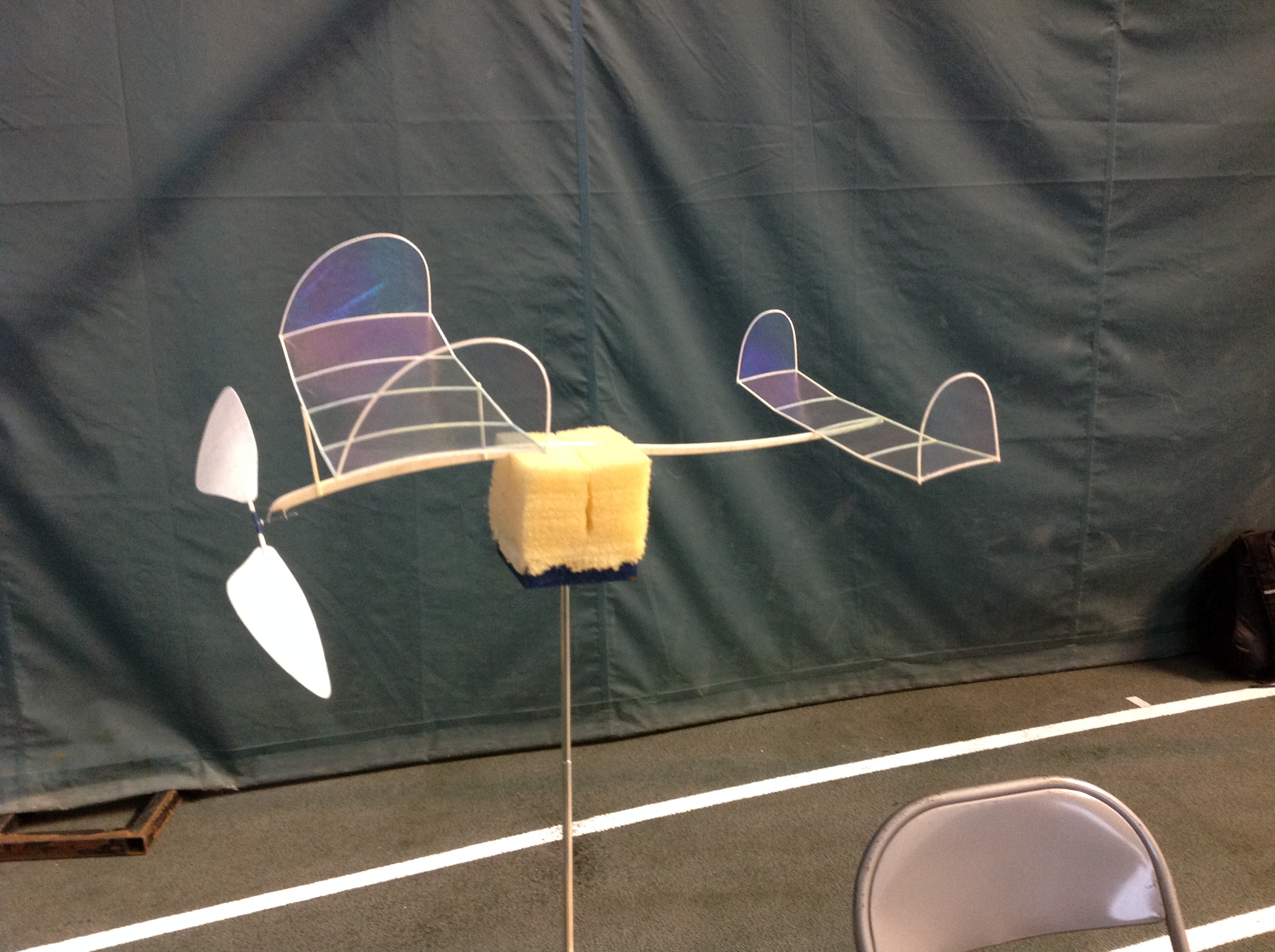
Click here to download a PDF of the plan.

Larry Loucka’s Record Setting F1L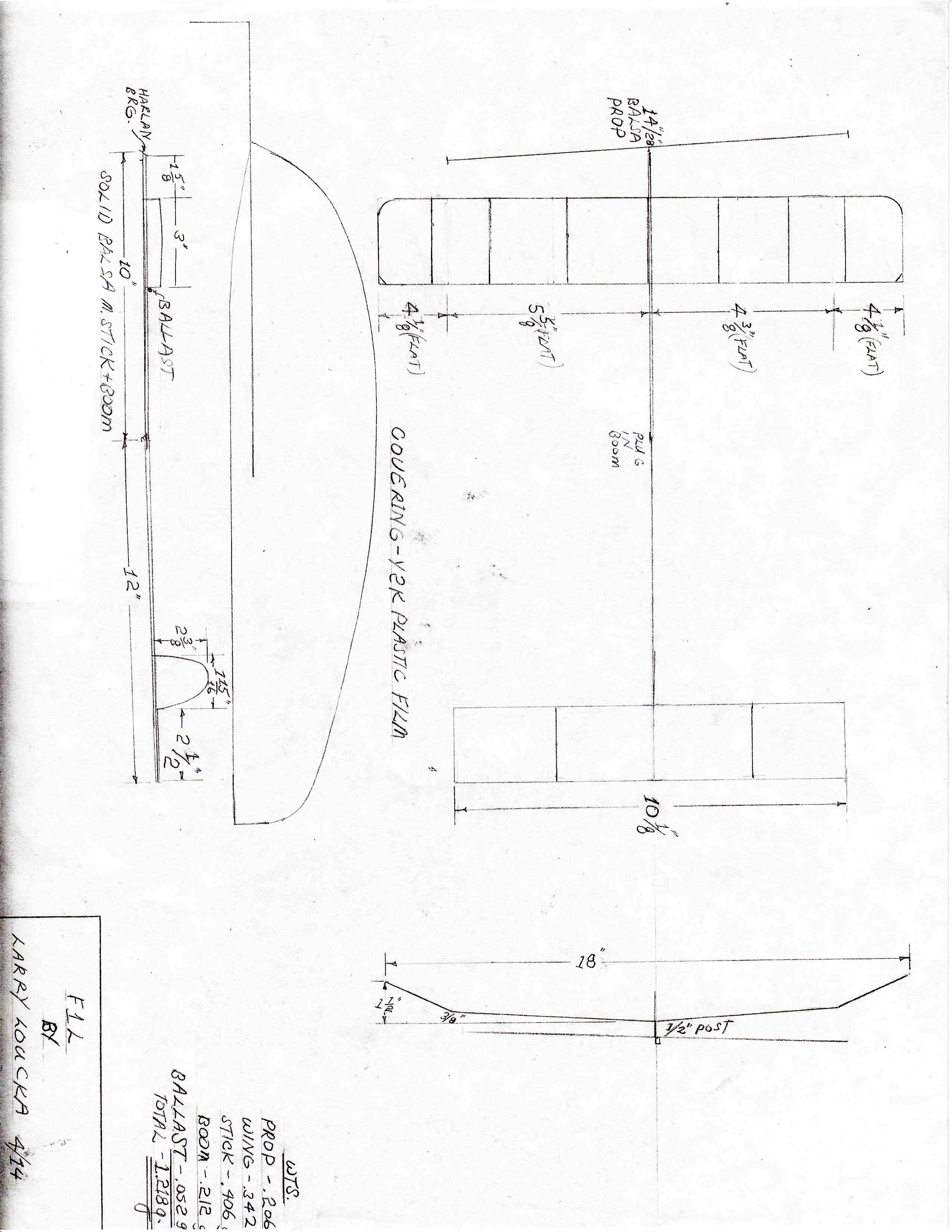
Click here to download a PDF of the plan.
Open F1L Cat III Record West Baden, IN
Rubber Specifications: 16 ½”, 0.062”, 0.045oz, 10/97 Tan II
Winding: Wound to 2275 turns, backed off 110 turns and landed with 80 turns.
Average RPMs: 106
Construction note: Prop blades grain is parallel to the spar.
Flight notes: On the previous flight, the model hung up on the plastic surrounding the saucer, and during retrieval the left hand wing tip was broken and a hole was put in the center section of the wing. The record flight was launched five minutes before the contest was over. There was no time to test fly after repairs. Again, the model played tag with the bottom of the saucer and the plastic on the opposite side from where it had hung up before. It did not touch the girder work. Only one pole steer was required to miss a chair before landing.
19:39 is my personal best in F1L. The design of the model is about the same as a paper-covered EZB my son and I built in the early 1980s. It weighed 0.050oz, but was a good, reliable flyer. My F1L is a little over 0.042oz.
I would recommend that anyone starting out in F1L read the “Serendipity” EZB article by Nolin that was published in the AMA magazine about 20 years ago. It was a very good run down of EZB trim.
~Larry Loucka
Tony Hebb’s F1R Plan
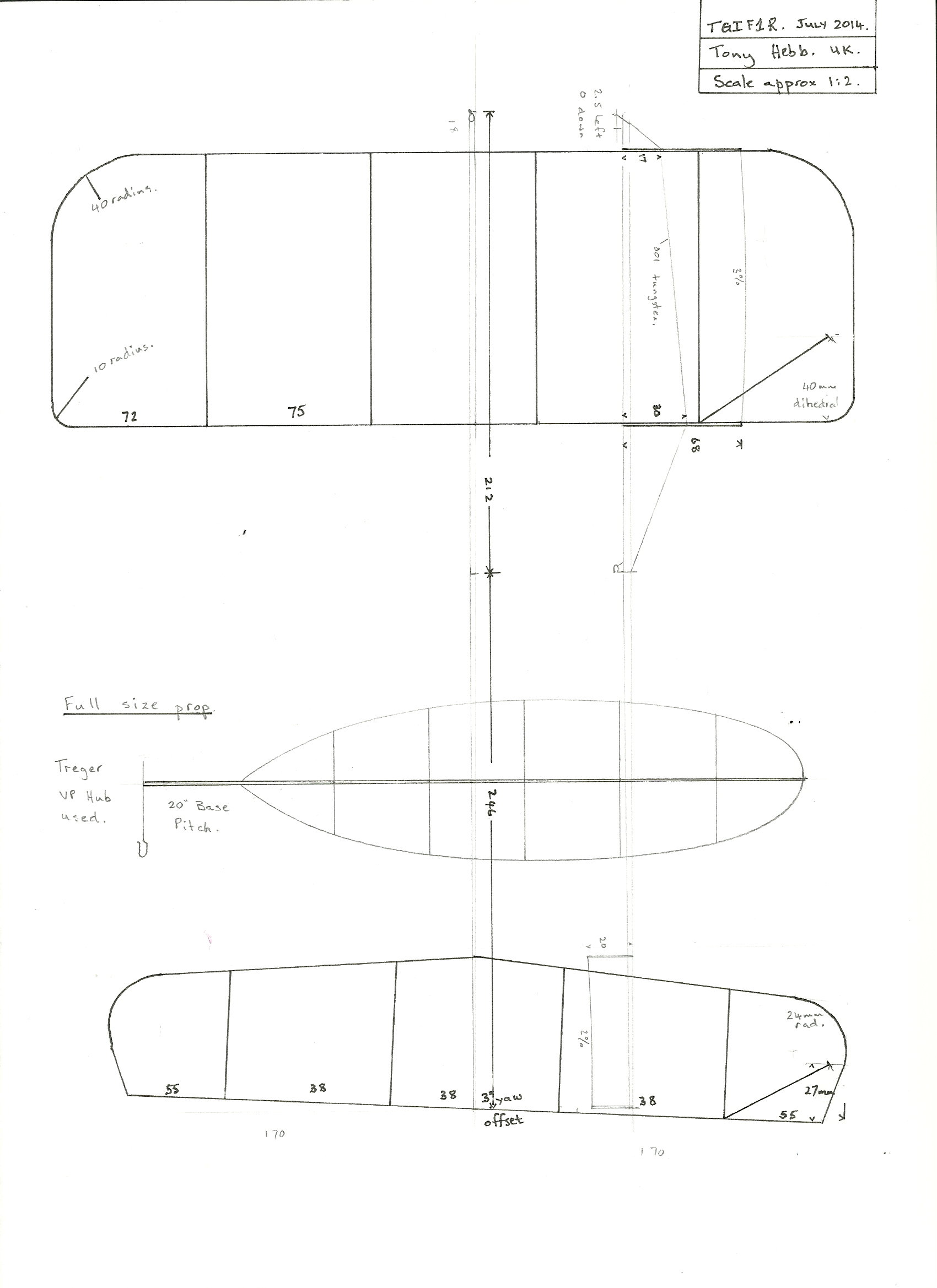
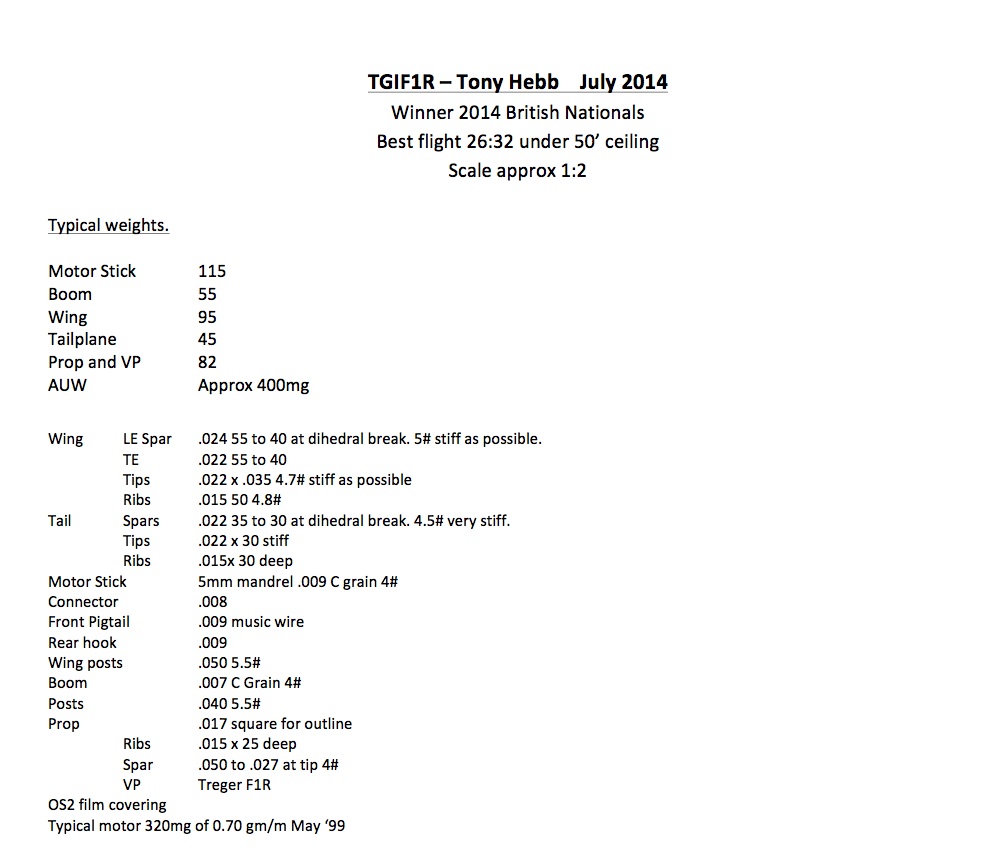
Click here to download a PDF of the plan.
Notes from Tony
The model is really Bob Bailey’s F1R with slightly simpler wing and tail outlines, also Bob flew with his own VP hub whereas mine flies predominantly with a Treger F1R hub which I can wholeheartedly recommend.
For anyone not wanting to use a VP then I would suggest that they use the flaring blade shape from Bob Baileys original model which works well.
All up weight is around 400mg and this is difficult to achieve with OS film whilst still retaining adequate airframe stiffness – so definitely not a beginners model. I still feel that 10 to 20 mg can be shaved off this, but I know I have yet to fly the model to it’s full potential even at this weight.
Best wishes,
Tony
Yuan Kang Lee’s 2014 World Championship F1D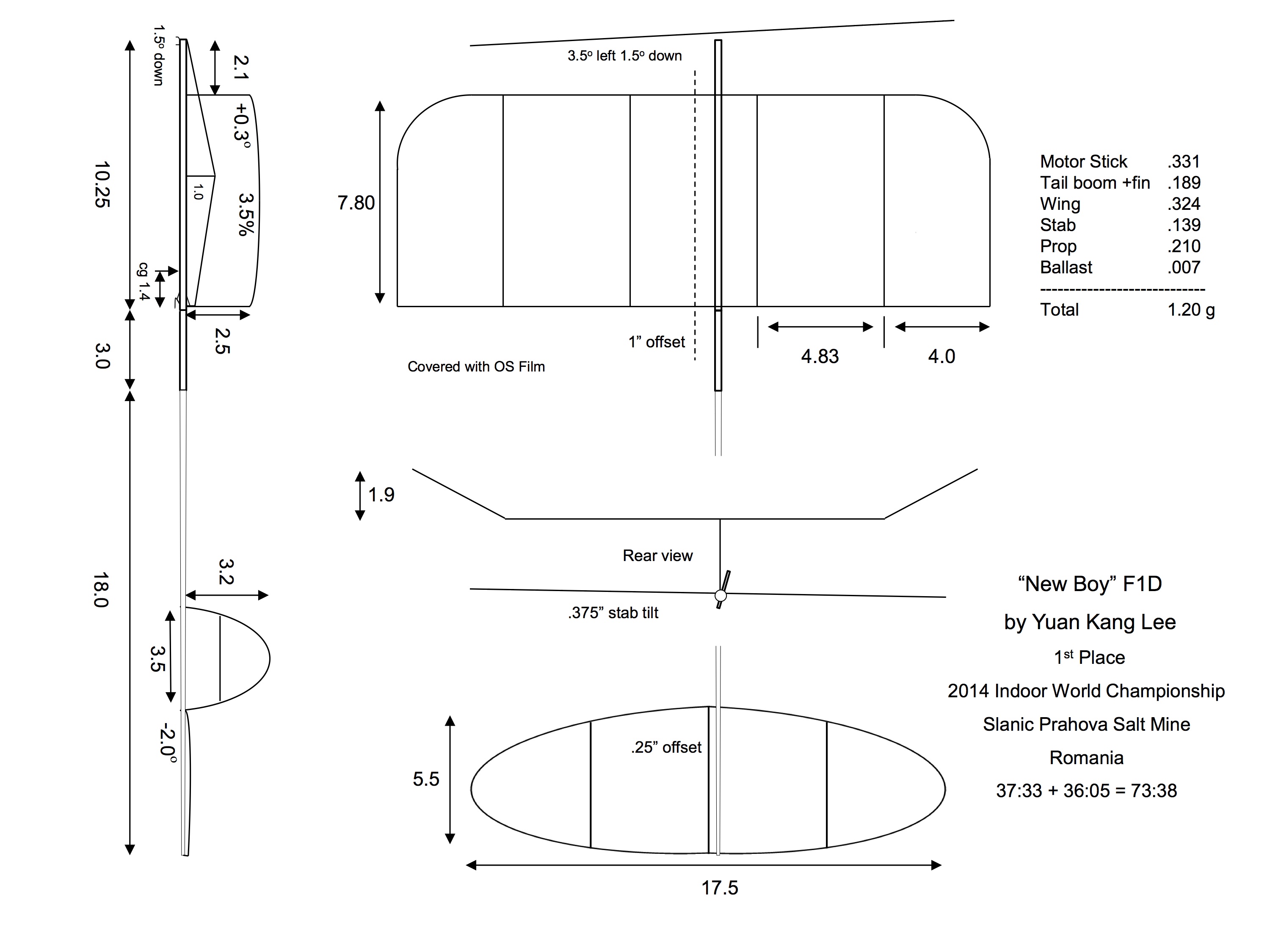

Click here to download a PDF of the plan.
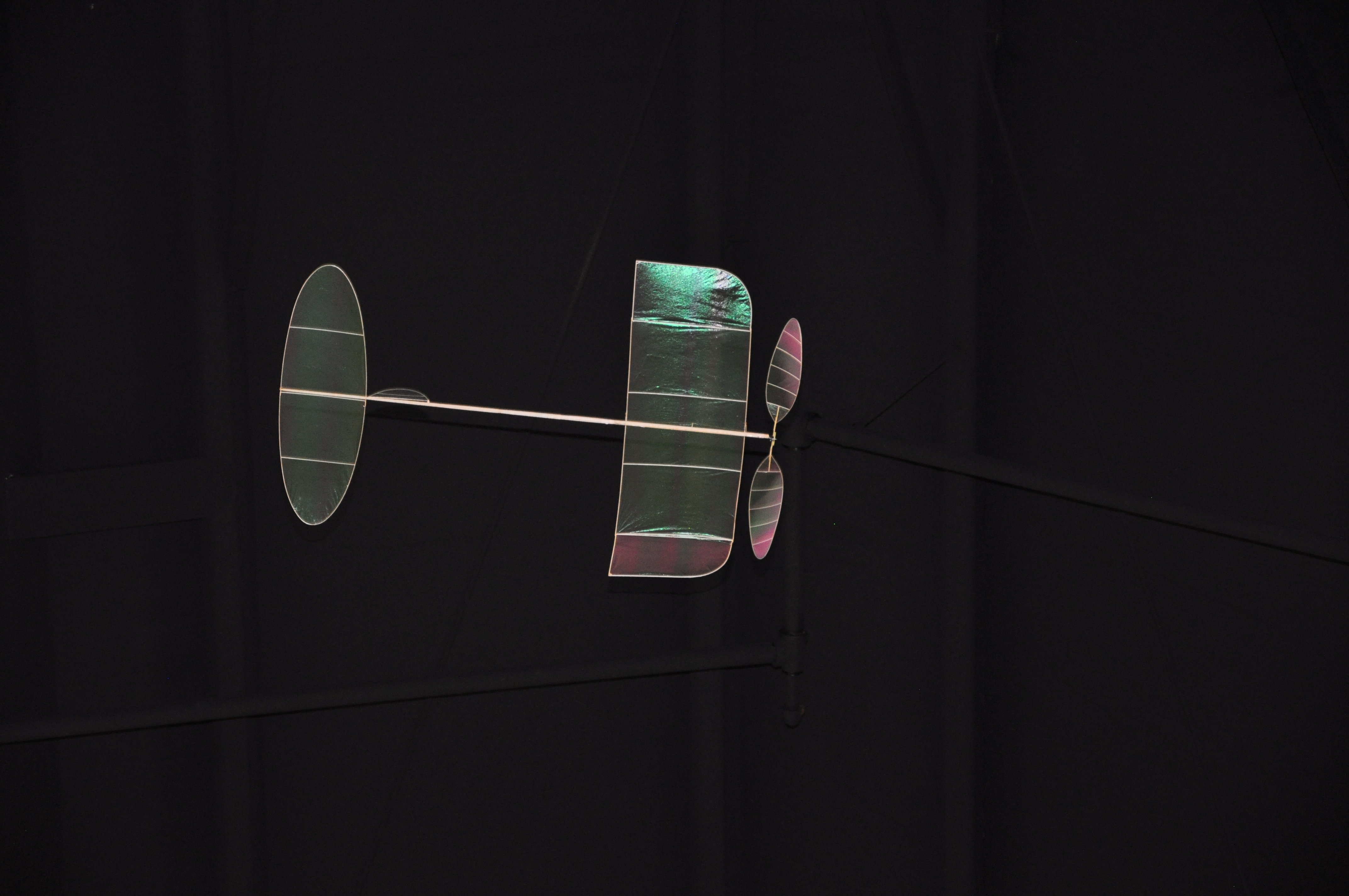
Yuan Kang Lee’s F1D In Flight
Nick Ray’s AMA Cat I Record F1D
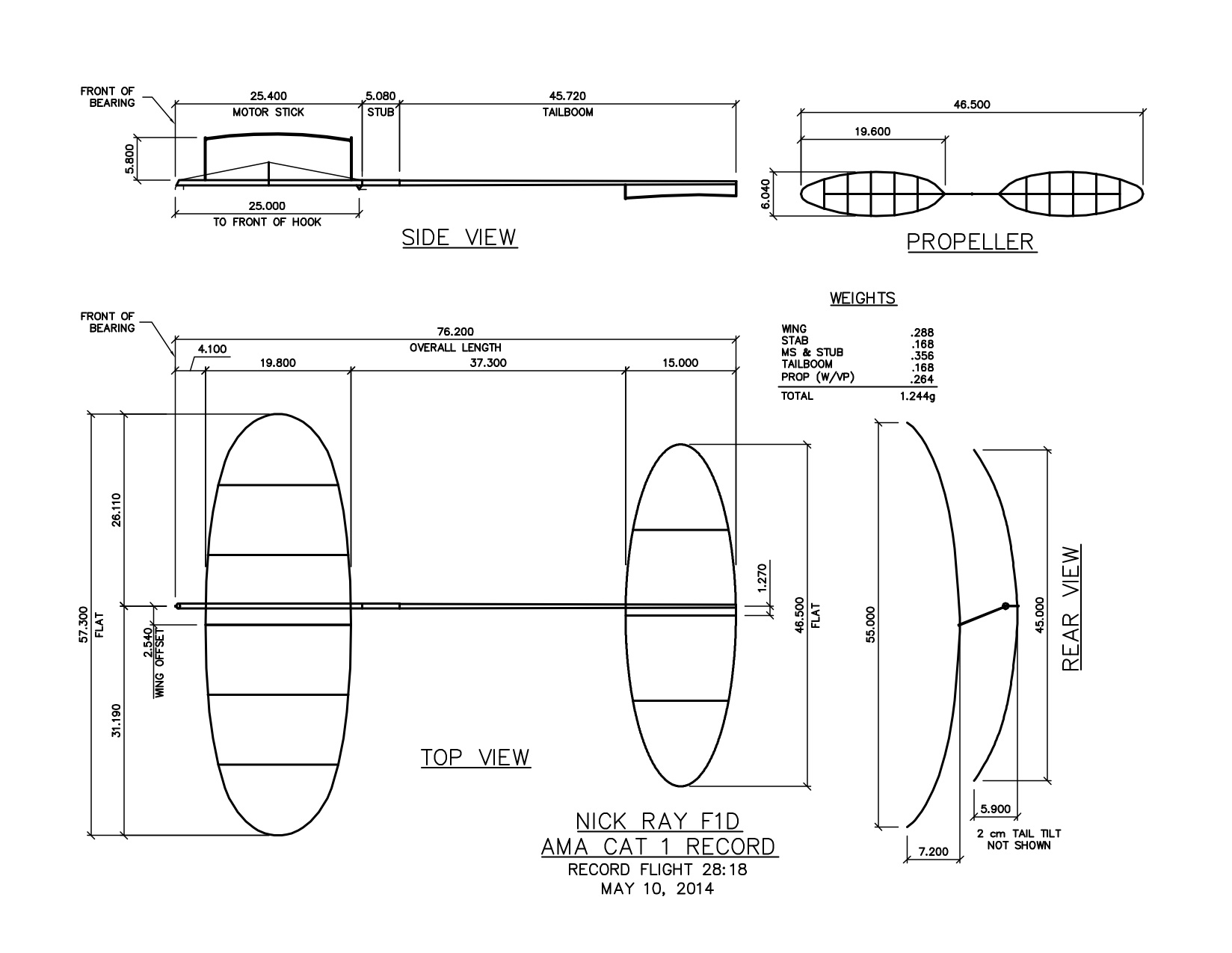 Click here to download a PDF of the plan.
 Click here to download a PDF of the materials list.
Notes on the Flight
The Cat I record flight was the product of my redeveloped F1D program, which began after the 2012 World Championships in Belgrade, Serbia. I incorporated Lutz Schramm’s work on drag reduction and Ivan Treger’s work on VP design. I chose to design the tail using the guidelines Martin Simon suggests in his book, Model Aircraft Aerodynamics. Mainly, when using a lifting tail, one should design it with all of the considerations due a wing. Although, visually, the model may appear to need a rudder, there is enough dihedral in the tail to facilitate a tight left turn.
Mark Bennett’s 2008 record notes also proved invaluable when trimming the model. I use a spring with 3.5 turns of 0.008″ music wire on a 0.039″ / 1 mm mandrel. This spring allowed me to keep the model off the ceiling for the majority of the flight. Generally, the model reached the ceiling around 4 minutes and continued to climb until approximately six minutes. The model then gradually descended to approximately 12 feet from the floor until 14 minutes, when the model began its second climb. The model climbed back to the ceiling, reaching ceiling height at approximately 17 minutes. The model began its final descent approximately 24 minutes into the flight.
This flight profile would not have been possible without outstanding rubber. I have tried several batches, but only May 99 has been able to deliver a strong second climb. The record flight was made on the third wind of a 9” loop of May 99. I was able to wind to 0.55 in-oz with 1650 turns, and back off to 1625 turns at 0.4 in-oz. I landed with 325 turns. The flight averaged 45.9 RPMs with a minimum of 34 RPMs before the propeller started to change, and a maximum of 53 RPMs during the final climb.
The day of the record flight was very humid and had a high of 75° F. I think warmer, drier weather may lead to slightly improved times. Furthermore, a stiffer spring may allow for the model to stay at the ceiling for the entirety of the flight, rather than wasting energy on multiple climbs. Another direction to explore would be sparless propellers. I have not had much luck with shorter motors, so for the time being I may be stuck with landing with several hundred turns.
l would like to thank Bill Gowen for drafting the plan for the model. He did a superb job rendering the complex curves.
~Nick Ray

Top View, Taken after the Cat I Record Flight

Side View, Taken at the completion of construction
Mike Kirda generously made CAD drawings of my rib templates.

Click here to download a PDF of the templates.
View more by category: Uncategorized (292). .





 Indoor News and Views