Archive for 2014

Statuses

AMA Rule Change Proposal

In Uncategorized on February 17, 2014 by nicholasandrewray

AMA Rule Change Proposal

Compiled by Steve Riley

The the following rule change proposal is currently before the Indoor Contest Board: 

 Brief summary of the proposed change. Add a new set of record categories for performance in sites located at higher altitudes .

These new categories would be based on the same ceiling heights as the current categories except they would apply to sites located at elevations of 5,000 feet above sea lever or greater.

  Flying for Record. National record performances shall be recognized for flights made in each of the following types of buildings:

Category I Buildings having ceilings less than 8 meters (26′ 3″).

Category II Buildings having ceilings between 8 and 15 meters (26′ 3″ to 49′ 2.5″).

Category III Buildings having ceilings between 15 and 30 meters (49′ 2.5″ to 98′ 5″).

Category IV Buildings having ceiling over 30 meters (higher than 98′ 5″).

Category I HA ( High Altitude) Buildings located at an elevation of 5000 feet above sea level or greater having ceilings less than 8 meters (26’3″)

Category II HA (High Altitude) Buildings located at an elevation of 5,000 feet above sea level or greater having ceilings between 8 meters and 15 meters (26’3″ to 19′ 2.5″)

Category III HA (High Altitude) Buildings located at an elevation of 5,000 feet above sea level or greater having ceilings between 15 and 30 meters (49′ 2.5″ to 98′ 5″)

Category IV HA High Altitude) Buildings located at an elevation of 5,000 feet above sea level or greater having ceiling over 30 meters high (98′ 5″)

Logic behind proposed change, including alleged shortcomings of the present rules. State intent for future reference.

There are many very good indoor sites located in the Rocky Mountain West that fail to attract the top level indoor competitors because it is not possible to set records at the altitude of these venues. This results in the sanctioning of events conflicting with sanctioned events in these sites resulting in financial losses to the clubs attempting to increase indoor participation in their area. This has a negative impact on the club’s ability to be involved with STEM and Science Olympiad programs. The establishing of the new high altitude record categories will create an incentive for current record holders to fly in these events. An another benefit of the addition of these new high altitude record categories is the clubs will benefit from learning form the top competitors who come to try for these new records.

Below is a list of the Indoor Contest Board members. AMA members are encouraged to express their views on this proposal to their representative. 

Boldface Below Indicates Chairman of Contest Board

INDOOR CONTEST BOARD
I: Ray Harlan, 15 Happy Hollow Rd., Wayland MA 01778
II: Mary Jane Barber, 23 Rabbit Run, East Hampton NJ 08060
III: Walt VanGorder, 5669 Victory View Ln., Cincinnati OH 45233
 
IV: John Diebolt, 526 Heater Dr., Cary NC 27511 
V: Bill Gowen, 2105 Heritage Heights, Decatur GA 30033 
VI: Larry Coslick, 4202 Valley Crest Hill, St. Louis MO 63128 
VII: Dennis Tyson, 657 W. Green St., Hastings, MI 49058
VIII: Jesse Shepherd, 2603 Norwood, Dr. Arlington, Texas 76013 
IX: H. Stan Chilton, 3010 Grail, Wichita KS 67211 
X: Clarence Mather, 2358 Tam O’Shanter Ave., Bishop CA 93514-1944 
XI: Andy Tagliafico, 10039 SW Quail Post Rd., Portland OR 97219

Statuses

Proposed Rule Changes to F1D

In Uncategorized on February 12, 2014 by nicholasandrewray

Proposed Rule Changes to F1D

Compiled by Joshua Finn

The February FFn from the UK carries the 2014 FAI rules change proposals for F1 (free flight) classes. Included in this set of proposals is a significant change to F1D. The following is a summary of the proposal and FFn’s editorial opinion. This information is provided by INAV in an attempt to keep indoor fliers aware of current rules proposals and is thus provided without the opinions of INAV authors or staff.

F1D Indoor rules

From Hungary

 In para 3.4.2.reduce the rubber weight and increase the model weight as follows

Minimum weight without rubber motor …………… 1.4 g.

Maximum weight of the lubricated rubber motor … 0.4 g.

Reason: The proposal intends to significantly reduce the flight times because of the decreasing availability of proper flying sites. Nowadays only two (!) large sites are available for world (Belgrade and Slanic) and one (Belgrade) for European championships! Both sites are facing privatization which might results the loosing of both because of the renting costs. The class has to be flown in smaller sites with shorter flights and shorter contests to survive.

The proposal keeps the surface loading in order to keep the beauty of the F1D models’ flying style. Besides the shorter times the 0,2 g addition to the model weight eliminates the effect of the only available heavier covering material, as the lightest plastic film is no longer manufactured since years. helps to make reliable variable pitch or diameter mechanisms and apply new, but heavier materials. Existing models will stay usable with 0.2 g spacers.

Hopefully these changes might encourage new flyers as it would be a bit easier to build down to weight. The top flyers might keep their chances to win but the gap could well be closed. Test flights were flown in Cat. II site (max. 15 m ceiling height) up to 23 to 24 minutes flight times which means about 30% reduction.

To help INAV better understand the thoughts of our readers, we have include a poll.

 It is also recommended that all indoor fliers who fly F1D or are interested in future participation in this class express their opinions to the CIAM Technical Expert(s) from their respective nations, since many of these representatives do not fly F1D and would appreciate input from the fliers they represent. As an aid to fliers unfamiliar with their nations’ technical experts, a full list of the CIAM F1 Technical Experts is included below. Additionally, all CIAM Technical Experts are listed at the FAI CIAM website: http://www.fai.org/ciam-about-us/ciam-officials-experts/101-ciam/34849-fai-technical-experts-for-aeromodelling

FAI Technical Experts for Aeromodelling:

Argentina

Daniel Hugo Iele

aerostar@advancedsl.com.ar

Australia

Graham Maynard

maynag@optusnet.com.au

Austria

Wolfgang Baier

woba@gmx.at

Austria

Helmut Fuss

helmut.fuss@tno.at

Austria

Wilhelm Kamp

wvkamp@arcor.de

Belarus

Yaroslav Vasiliev

gena_letchik@mail.ru

Belgium

Cenny Breeman

ciam@breeman.be

Bulgaria

Valentin Savov

valio@dir.bg

Czech Rep.

Ivan Horejsi

info@horejsi.cz

Finland

Ossi Kilpeläinen

ossi.kil@iki.fi

Former Yugoslav Rep. of Macedonia

Zdravko Todoroski

zdravkot@t-home.mk

France

Pierre Chaussebourg

pierre.chaussebourg@wanadoo.fr

Germany

Bernhard Schwendemann

beschwende@aol.com

Hungary

Andor Harmath

andor.harmath@invitel.hu

Hungary

András Reé

ree@eik.bme.hu

Italy

Gianni Cesare

cesaregianni2@virgilio.it

Japan

Masaru Koike

mkoike@med.oit.ac.kjp

Netherlands

Allard van Wallene

avanwallene@epo.org

New Zealand

David Ackery

david.ackery@extra.co.nz

Norway

Tor Bortne

email unknown

Norway

Ingolf Steffensen

email unknown

Poland

Edward Burek

msml@poczta.fm

Poland

Stanislaw Kubit

gbit@digi.pl

Portugal

Jorge Gustavo

jorge.gustavo@tvtel.pt

Romania

Cringu Alexandru Popa

cringupopa@gmail.com

Romania

Viorel Salistean

vasile.salistean@yahoo.com

Russia

Sergei Makarov

makaros3@yandex.ru

Serbia

Svetozar Gostojic

office@vss.rs

Slovakia

Jakub Drmla

jdrmla@yahoo.com

Spain

Javier Hernandez Abad

f1a498@gmail.com

Sweden

Per Findahl

per.findahl@gmail.com

Switzerland

Christoph Bachmann

chbachma@solnet.ch

Turkey

Mehmet Arslan

arslanthk@yahoo.com

Turkey

Tamer Ekinci

tamerthk@yahoo.com

Turkey

Hami Gurtunca

hami.gurtunca@thk.org.tr

United Kingdom

Ian W. Kaynes

kaynes@btinternet.com

USA

Chuck Etherington

chuck.etherington@jeppesen.com

Statuses

Annual Editor’s Update

In Uncategorized on February 5, 2014 by nicholasandrewray

Annual Editor’s Update

Dear INAV Reads and Contributors,

It has been a little over a year since INAV was resurrected and reconstituted as a digital publication. INAV is currently being read by more people than ever before. The increase in readership is largely due to a growth in international readership. Approximately 60% of INAV readers now reside outside the United States.

In the coming year I will continue to work to ensure that INAV’s content increasingly grows to reflect its international readership. To reach this goal, I ask that everyone who reads INAV ask themselves what is going on where they fly that others might like to read about. What seems normal in one part of the world may be quite novel elsewhere.

I am pleased to announce that all of the content INAV has published in its 53 year history is now available online, free of charge, on our downloads page. Efforts have been made to make these documents searchable, though in several cases the poor quality of the original documents has led to PDFs that cannot be searched accurately. We are currently creating a PDF of the material published this passed calendar year. It will made available in the downloads section when it is complete.

Furthermore, INAV’s financial situation has stabilized. At the close of Abram Van Dover’s time as editor and publisher, Abram donated the remaining funds held by INAV to the National Free Flight Society. When I took over INAV, there was no operational budget. With the help of John Kagan, we have been able to secure annual funding for INAV through the National Free Flight Society, which covers the cost of running the website.

I want to thank all the authors who have made INAV possible this past year. I am looking forward to hearing more from you all, as well as reading new authors for the first time. I would also like to thank Nick Aikman, Mike Kirda, Tony Pavel and Jeff Hood for aiding me in searching out and soliciting content, in addition to writing articles. Thanks to its authors and readers, INAV has much to look forward to in this coming year.

Regards,

Nick Ray, Editor

Statuses

A New Indoor Flying Publication

In Uncategorized on February 2, 2014 by nicholasandrewray

A New Indoor Flying Publication Titel_Saalflug
Author: Heinrich Eder
Title: Alles über Saalflug
Vom Gummiantrieb bis zum Micro-RC-Modell
(All about indoor flying –
from rubber drive to RC-Micro-Models
with 20 plans for indoor models)
only available in German
Publisher:
Verlag für Technik und Handwerk (VTH), Baden Baden, 2014
ISBN 978-3-88180-455-4
Euro 24,80

Statuses

A quick note on using polyimide tubing

In Uncategorized on February 1, 2014 by propblocks

A quick note on using polyimide tubing

By: Mike Kirda

I can’t make tissue tubes consistently to save my life. I can make a dozen just to get one that fits. Then I go to replace a component and discover it won’t fit due to different size tissue tubes. Frustrating to say the least.

I believe I first heard about Polyimide tubing from Jake Palmer. He sent me some and I immediately fell in love with the stuff. You can get in all kinds of sizes. Amazon Supply is probably the easiest source. Various medical supply houses can supply others – A quick search on Google will find you several suppliers.

So what is it and why is it better?

Single and double wall - Double is much darker

Single and double wall – Double is much darker

The tubing is straight, strong, light and consistently sized. For the non-chemists, it is kind of like plastic/nylon tubing, but thinner. It will come in three wall sizes, they call it single, double and triple wall – Essentially 0.00125, 0.0025, or 0.00375″ thick walls. For our purposes, single or double wall is ideal. Single wall is typically sufficient for lighter classes, double wall for heavier.

The tubing is ideal for connecting parts. Wings to wing posts. Stabs to stab posts. Prop shafts to prop hubs. You get the idea – anywhere tissue tubes are typically used.

The one down side – nothing we typically use for glue likes to stick to it. There is one pre-step to gluing. Wherever you need to glue it down, you need to coat the tube with the lightest amount of thin cyanoacrylic (CA) you can get away with. Ambroid/Duco stick well to CA.

For wing posts attached to a fuse, a light bit on one side is all you need.

For attaching a wing to a wing post, a bit of glue on the contact surface and on the sides. A bit of balsa triangle will help to anchor the post to the wing.

For a prop spar, you need a bit of CA on just on the inside of the tube, then use the normal celluloid glues. A touch of acetone will loosen it up without fear that the tissue tube itself will turn to mush.

Use a bit aluminum foil as a pot for thin CA and a pin to dip into the CA and apply it to the tubing.

Matching wing posts to the tubing can be done in few ways:

  1. Careful sanding
  2. Use of a draw plate to as a dowel maker for balsa
  3. Use of the tubing itself – Just jam it into the tube and it will remove the excess. (This is my current favorite.)

Cutting the tubing may be a bit tricky at first.

  • For parts that do not require a lot of insertion – i.e. prop spar tubes, I just use sharp scissors.
  • For other parts, it is best to shove a bit of light scrap balsa into the tube, then use a razor blade to cut it. I just use whatever double edge blade I have on hand typically to cut it this way. A sharp single edge blade should also work well.
  • Art Holtzman has offered another way – Insert a numbered drill bit that fits inside and cut with blade around the bit.

A public thanks to Jake Palmer for turning me on to this tubing and also LeoP and Kang Lee for the initial help in learning how to use it.

I also have some for sale – 0.080″ ID single wall tubing that is ideal for F1D VP hubs. See: http://propblocks.com/miscellaneous-stuff/

Statuses

Tony Hebb’s F1D

In Uncategorized on January 27, 2014 by nicholasandrewray


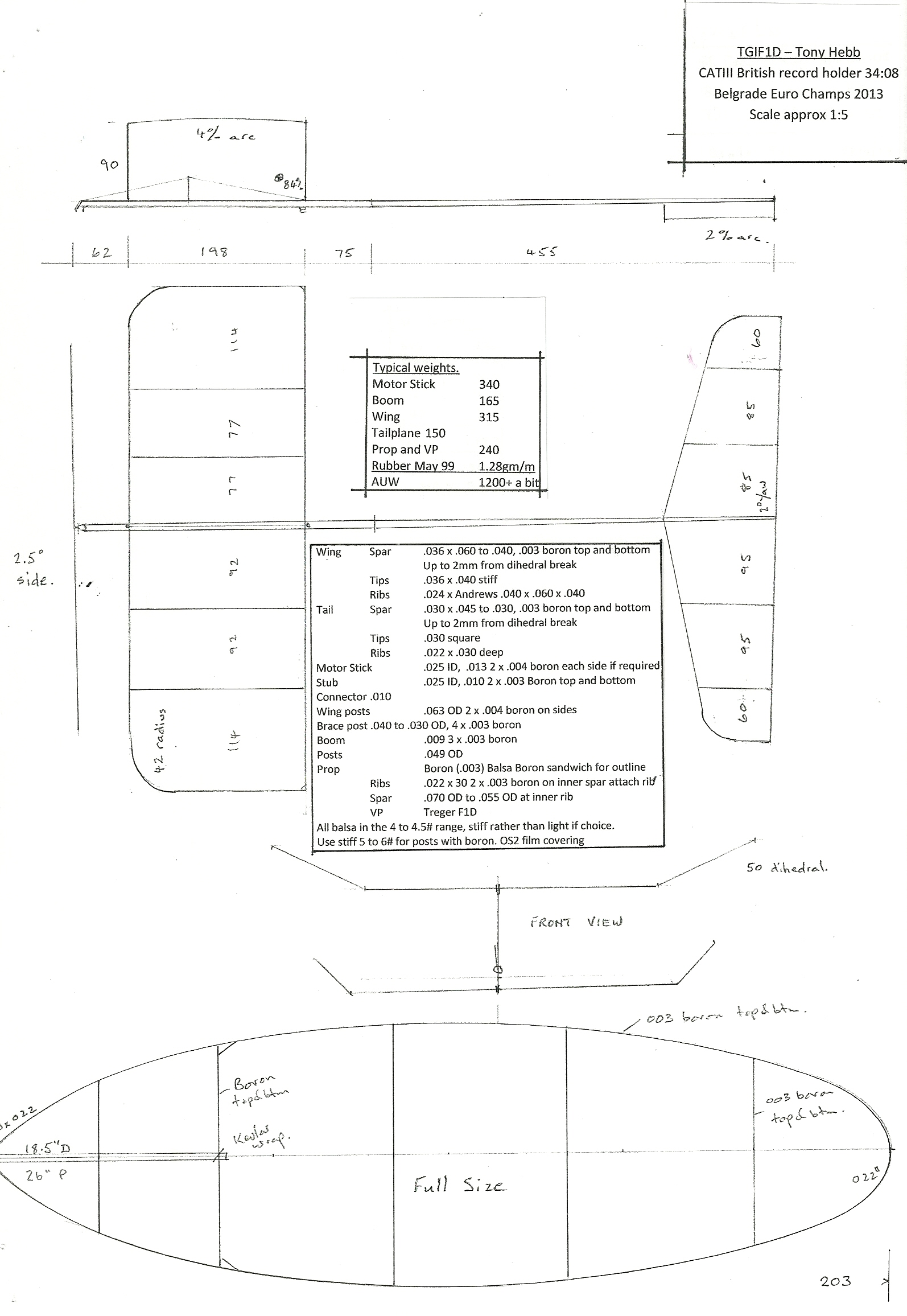
Tony Hebb’s F1DTGIF1D plan0001Click here to download a PDF of Tony’s plan.


Statuses

Indoor flying with Supercaps

In Uncategorized on January 10, 2014 by nicholasandrewray

Indoor flying with Supercaps

We are a group of 6 or 7 indoor flyers in Southern Germany using the new high density capacitors such as the “Green Caps” from Samwha for powering indoor models. The supercaps have a 5 or 10 Farad capacity and weigh about 2 or 3 grams. If one cuts the legs and removes the plastic coating the caps get about 0.3 gms lighter. Principally, one can use the structure of an F1M or F1L with a lighter fuselage, because the extreme torques caused by the rubber band are missing. The structure should weigh about 1.4 gms and be strong enough to bear 5 or 6 gms in total. The coreless 6 mm pager motor with a resistance of 10 or 30 Ohms weighs 1.3 gms and the 1:6.6 or 1:9 gear another0.7 gm. We also tested 4 mm coreless motors that are also usable but the gear with modul 0.2 is more difficult to handle. The 6 mm types show about 50% efficiency, the 4 mm types only 35-40%. Total efficiency of the drive ranges at about 20%, including propeller and gear losses. Depending on the equipment, the ready to fly weights range from 5.0 to 6.2 gms.

The propeller diameters range from 120 to 135 mm and the pitch ranges from 70 to 110 mm depending on the gear ratio. I use blades made from 0.4 mm C-grain with spars from 0.7 mm CF. Other people make their blades from thin plastic (yogurt) cans.

What are the flight times? We started with 1:30 min and now – one year later – we are at 5:30 min. Theoretically,  with a medium current of 30 mA, a flight time of max. 6 minutes should be  possible. Roland Oehmann flew already 5:40. The green caps with a 2.7 Volts reference value can obviously be loaded up to 3.4 Volts taking no noticable damage. Then, a voltage range from 3.4 to 2.2 Volts is usable. Load times are from 30 to 60 seconds depending from capacity. Note: If the final voltage is reached the current flows another 10 to 20 seconds enhancing the total charge of the cap.

Charging is possible from any power supply that allows for a 3.4 Volts default value. No preresistor is necessary. Some people use a full 4.15 Volts Lithium cell and a silicon diode with the 0.7 Volts gap voltage loss in series. Please mind the high load currents of some Amps in the first seconds. But you can also cut them by presetting an upper current-limit.

Motors and gears come from www.Didel.com

Author: Heinrich Eder, Munich, Germany, eder-h@arcor.de

Pics:

1 The authors "Capino I" driven by a 4 mm coreless motor, gear ratio 1:10 and a 5 Farad Green Cap

1 The authors “Capino I” driven by a 4 mm coreless motor, gear ratio 1:10 and a 5 Farad Green Cap

P1020109

2 “Capino 2” is driven by a 6 mm coreless motor 30 Ohm with a 1:9 gear

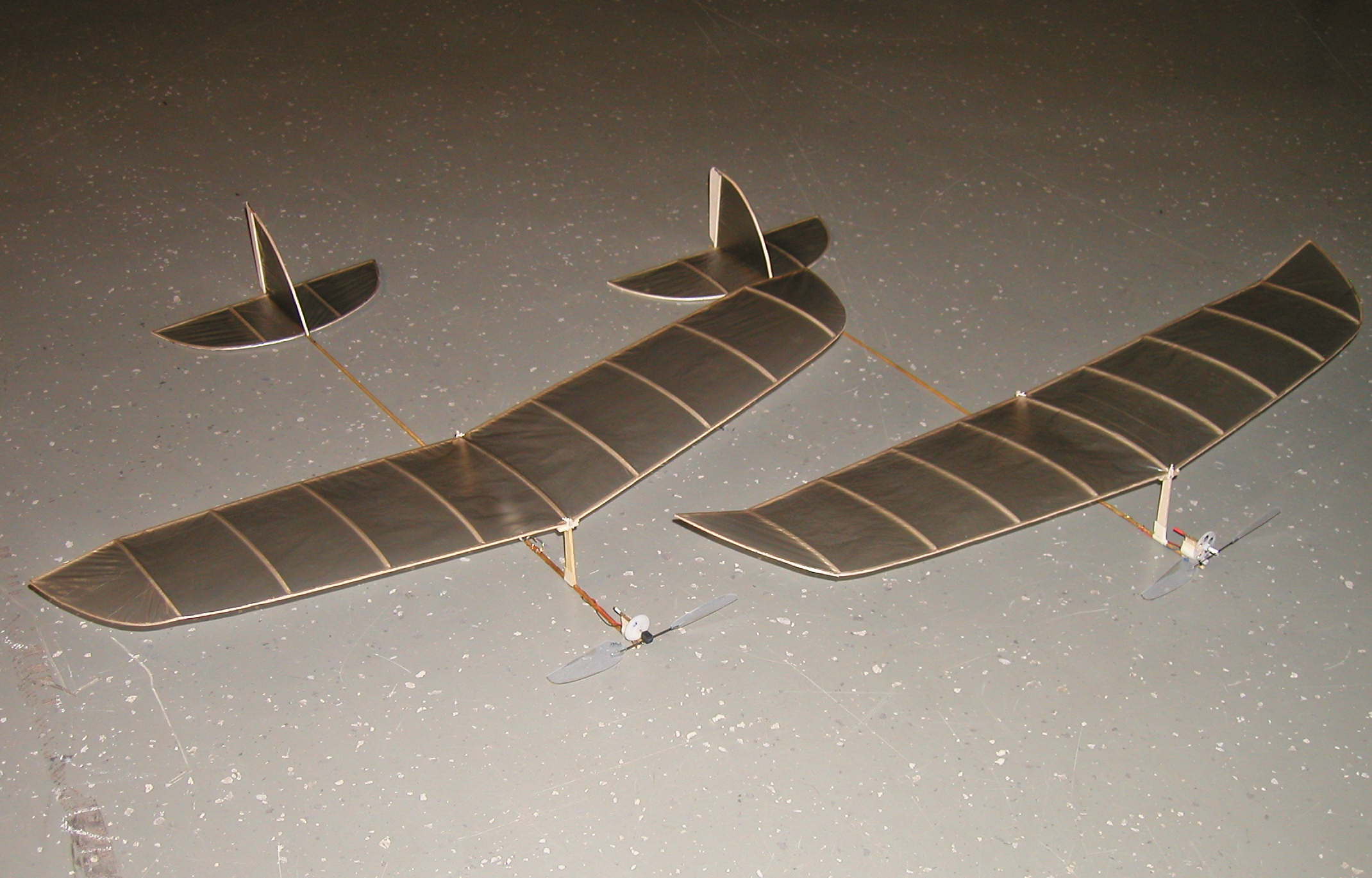
3 The models "Cappy I and Cappy II" from Roland Oehmann, Stuttgart, Germany

3 The models “Cappy I and Cappy II” from Roland Oehmann, Stuttgart, Germany

Statuses

LPP Carbon Prop Spar

In Uncategorized on January 10, 2014 by propblocks

LPP Carbon Prop Spar

By Mike Kirda

Recently I built a Limited Penny Plane to compete in the Bong Eagles contest. I’ve been pretty hard on LPP props in the past – Racine Memorial Hall’s ceiling is quite scrubbable, but I still broke my fair share. Determined to avoid this, I built a very robust prop spar: 7# balsa, 0.125″ center tapered to 0.080″ tip.

On my last flight of the day, the plane hit a railing and broke the prop spar while walking down the wall. It was centered on an open door and flew into the next room where many contestants were set up. All had a good laugh as my ‘Korda Wakefield’ continued to bang around the ceiling just out of reach for the next couple of minutes.

I wasn’t very happy to be honest – I kept thinking “Stupid Spar”. I thought back to Kang Lee’s Carbon VP hub and the carbon tube it used and wondered how well it would work…

The carbon tube is very strong and the blades needed less support than I imagined. I built a couple of new props using the carbon tube, trying them out at the next flying session and they worked very well.

One bit about carbon: Be careful around the dust. I use a vacuum to keep it down, plus use a particulate mask if cutting it indoors. Outdoor might be a better option. All cuts are made with a Dremel and diamond cutoff wheel.

To make the carbon spar, cut a length of 0.039″ carbon tube ~4″ long.

Alternatively you might just want to drill the hole 2″ from the end of the tube before cutting it off. This way if you goof up, you only lose 2″ instead of 4.

A bit of experimentation on length here might be best. At the center, drill a hole through using a #80 drill bit on a drill press. This fits a 0.013″ prop shaft perfectly. Alternatively a #78 or #79 bit should work if you want to use 0.015″ music wire instead.
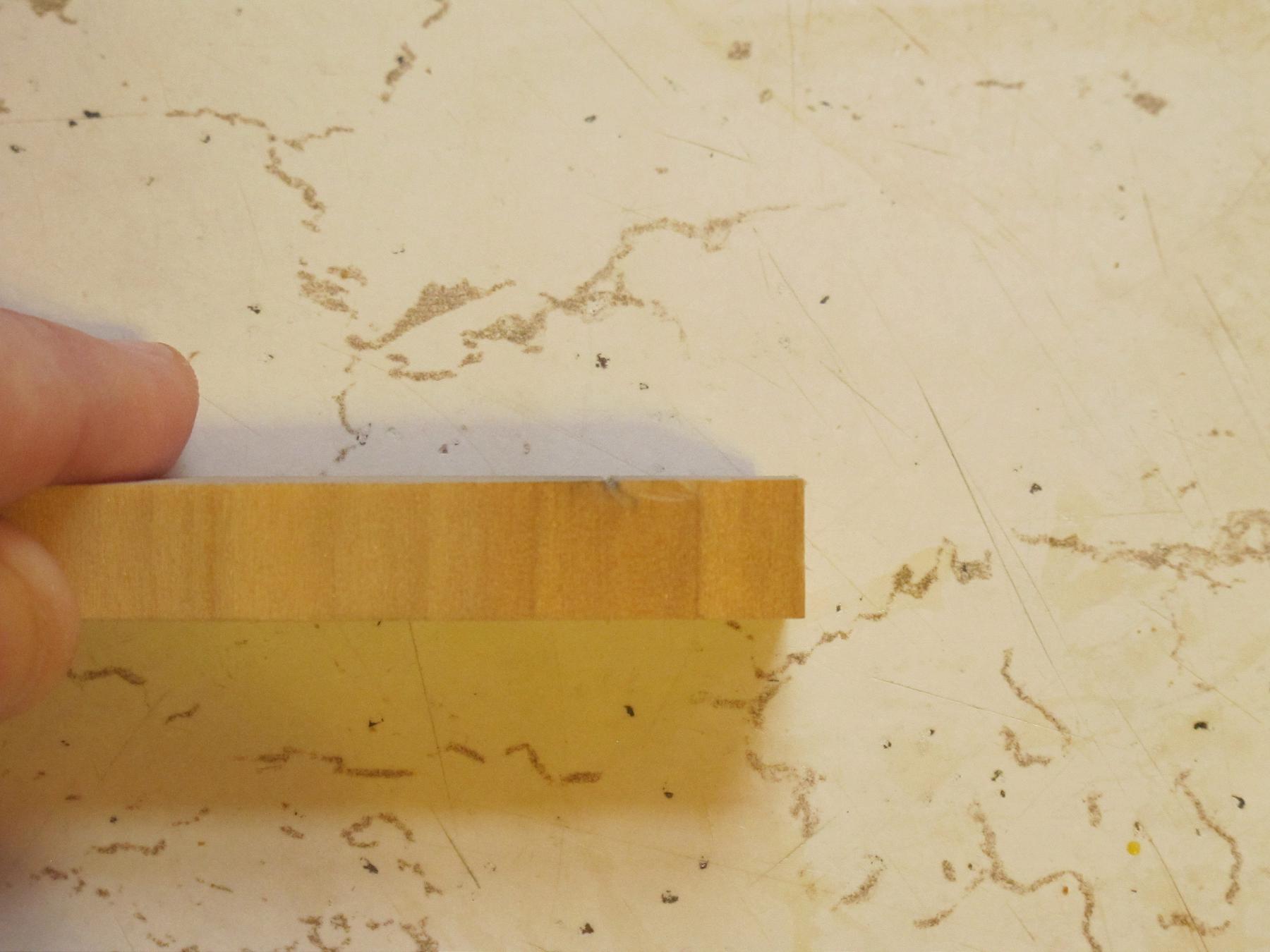
The best way to drill the hole is to lock the tube tightly into a 0.040″ slot.

You can purchase a router bit this size and feed a bit of wood through a router table (or drill press very slowly) to get the slot cut. Alternatively a bit of 1/16″ ply base with some 1/32″ ply to make a 0.040″ gap would work.

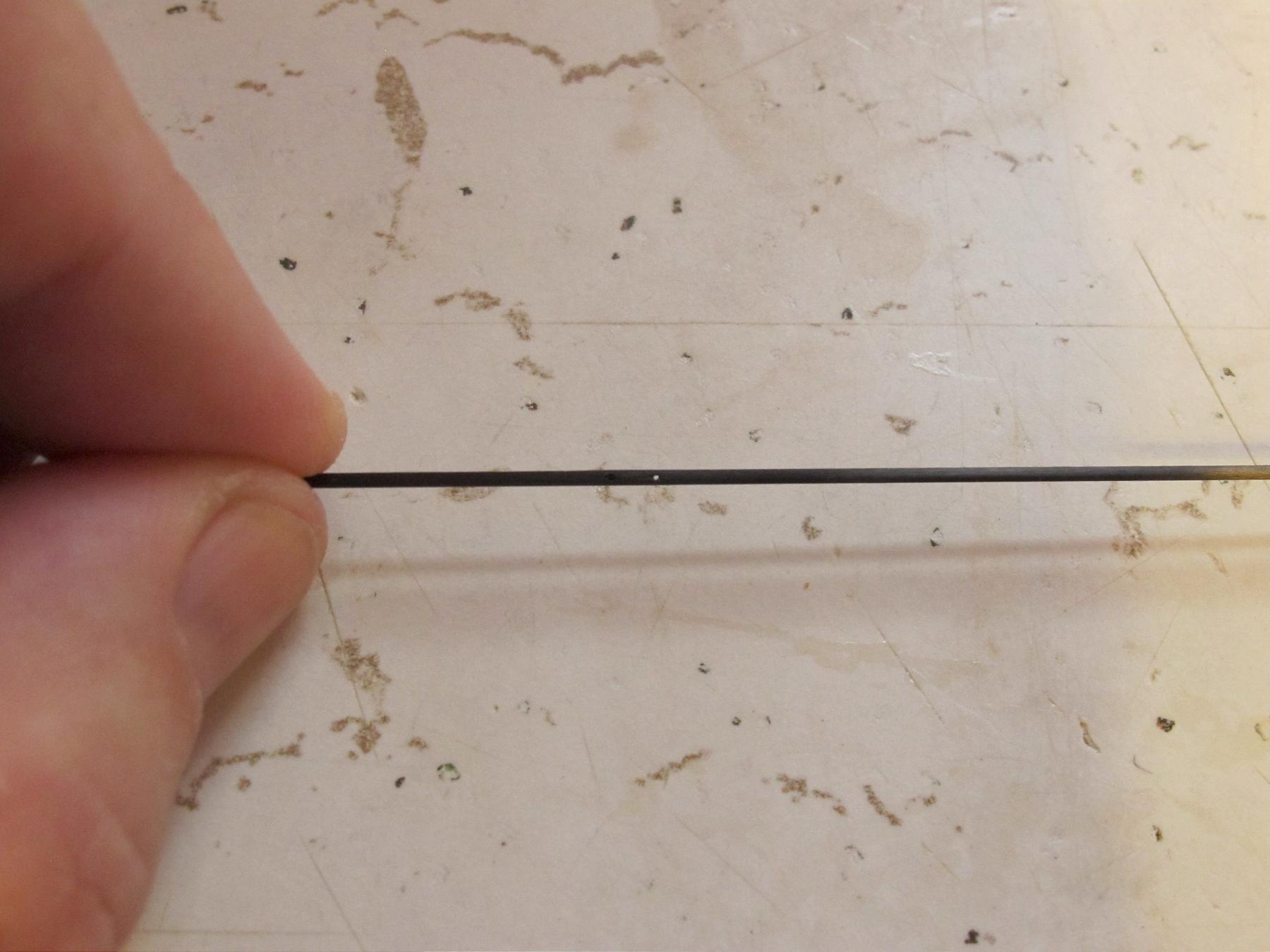
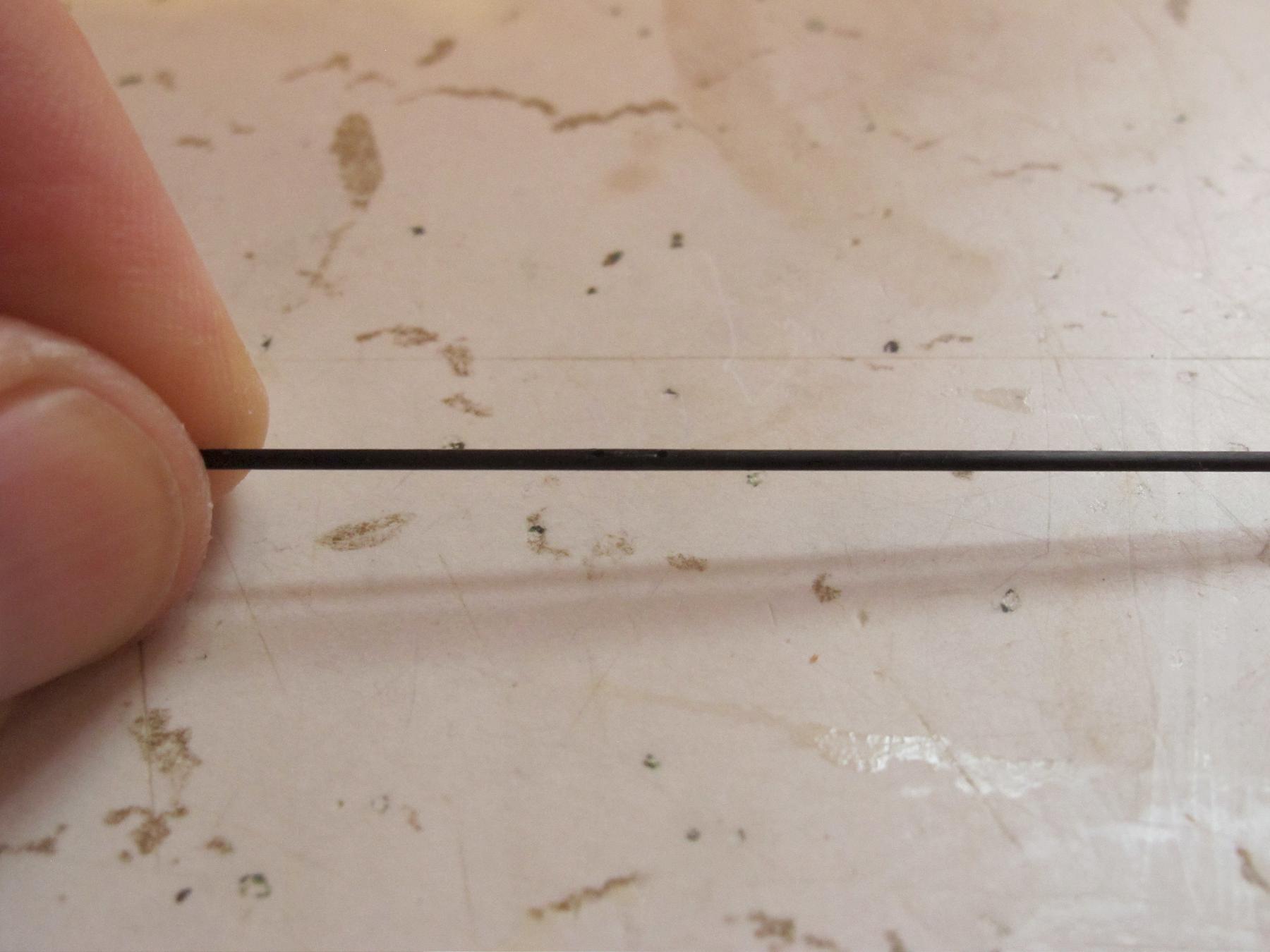
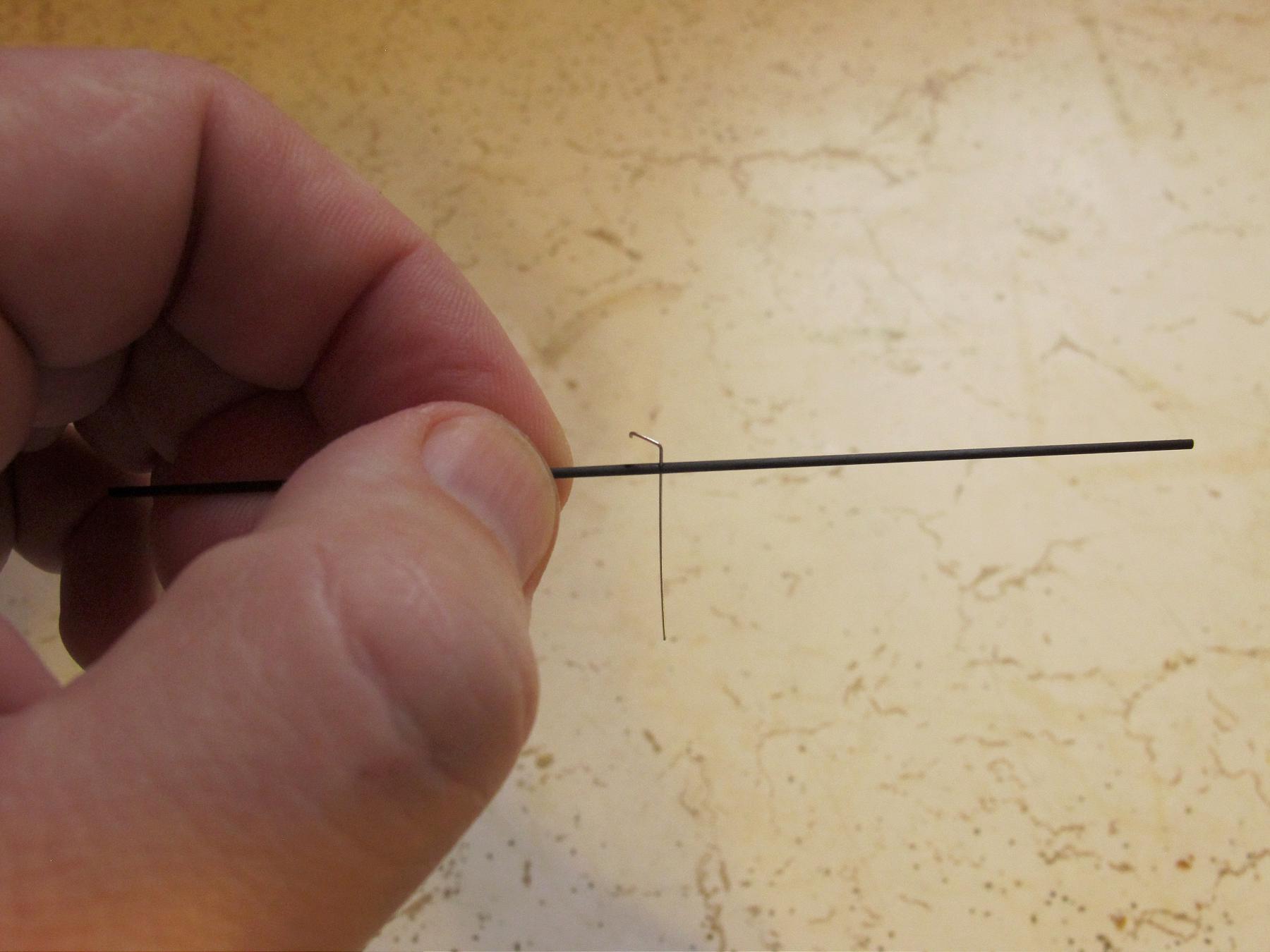
Next I drill another hole about 1/8″ away from the center, drilling just to the center of the tube. You can bend the prop shaft over to go into this hole. A bit of Kevlar thread and glue will bind it together. Just add a Teflon washer and rubber hook to your liking.

Next put the the spar into your prop pitch fixture. Add glue (Ambroid) directly to the carbon tube, then put the blade on top. Quickly tape the blade in place with blue tape. The spar may also be taped to the underside of the blade. Let dry completely, then check the pitch. Sometimes the glue shrinkage will change the pitch. A bit of acetone to loosen it, twist a bit more in the opposite direction, then let dry. Keep at it until you get it right. Adding plasticizers to the glue may help.

CST or ACP will carry the 0.039″ carbon tube. You may be able to order through a local hobby shop.

Slot for drilling jig

Slot for drilling jig

Side view of slot for drilling jig

Side view of slot for drilling jig

Tube pushed into place for illustration

Tube pushed into place for illustration

Holes from top

Holes from top

Tube turned slightly to show both holes

Tube turned slightly to show both holes

Prop shaft inserted

Prop shaft inserted – Not aligned to show hole.

Alternative prop shaft holder does not require second hole

Alternative prop shaft holder does not require second hole

Spar glued onto prop blade

Spar glued onto prop blade