


 If you would like to download a PDF of Kang’s CAD drawing click here.
~Kang Lee
Editorial Note: Kang sent this design in as an alternative to his first hub. Both hubs are still in the design stage and he welcomes your feedback.

If you would like to download a PDF of Kang’s CAD drawing click here.
~Kang Lee
Editorial Note: Kang sent this design in as an alternative to his first hub. Both hubs are still in the design stage and he welcomes your feedback.
Kang Lee’s All Carbon VP
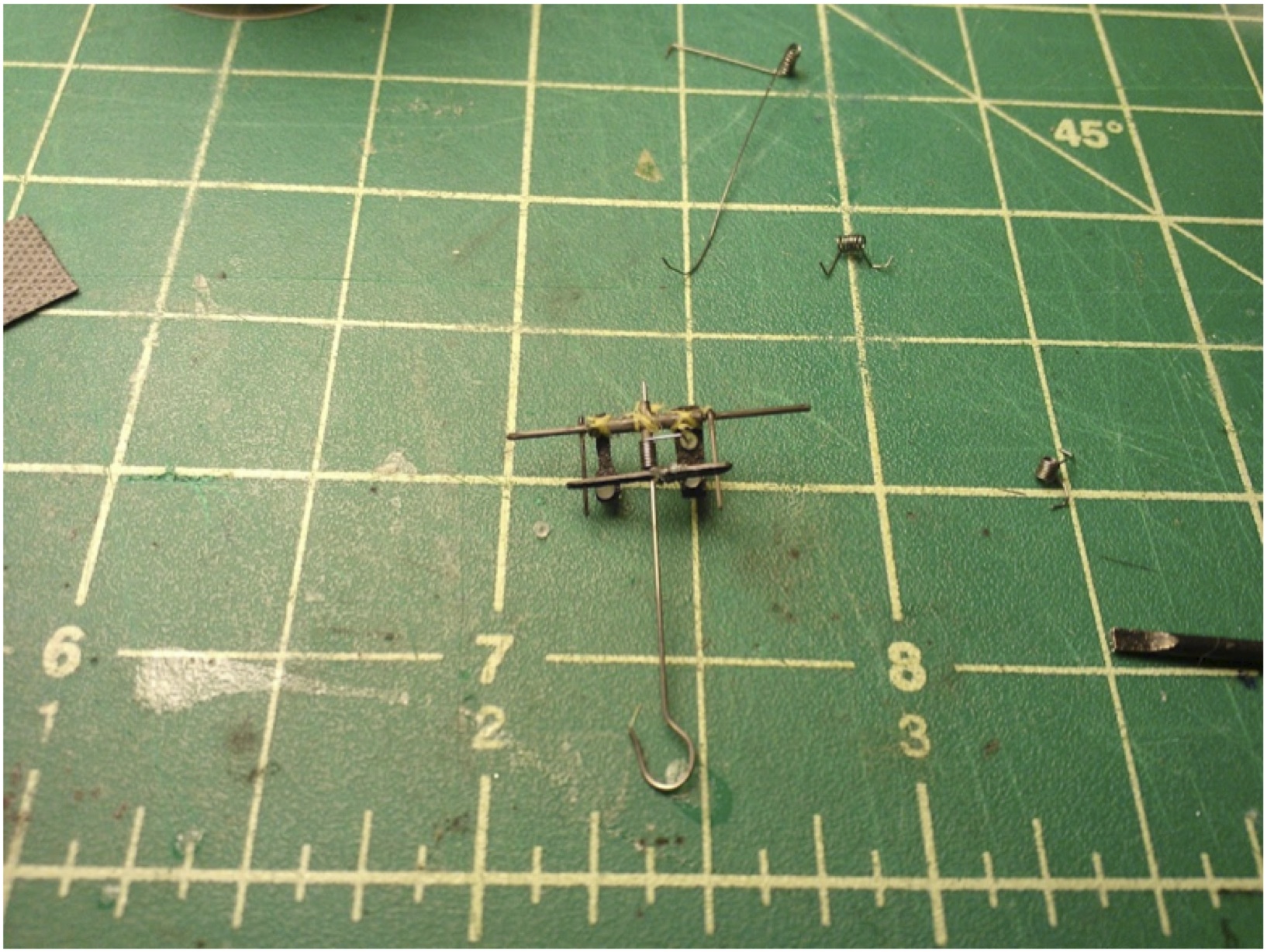
Back view of VP hub.
All joints are glued using thin CA. Kevlar is used to secure the hub to shaft sleeve joint, as well as the screw holders to hub joint.
Spring is 9.5 turns of .008” music wire formed over a .025” mandrel. Here, prop shaft is .013” music wire.
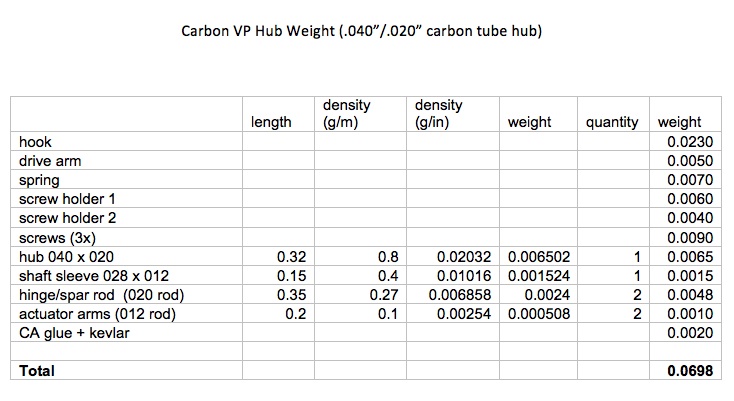
See diagrams for the dimensions of hub components. All carbon components are off-the-shelf, affordable, and fairly easy to work with.
The VP hub as shown weighs 70 mg. The hub is both stiff and light and can probably survive exploding motors.
There is some binding between the rod and the tube. I can hear the VP pop into low pitch. One solution may be the use of graphite lubricant.
Your feedback is welcome.
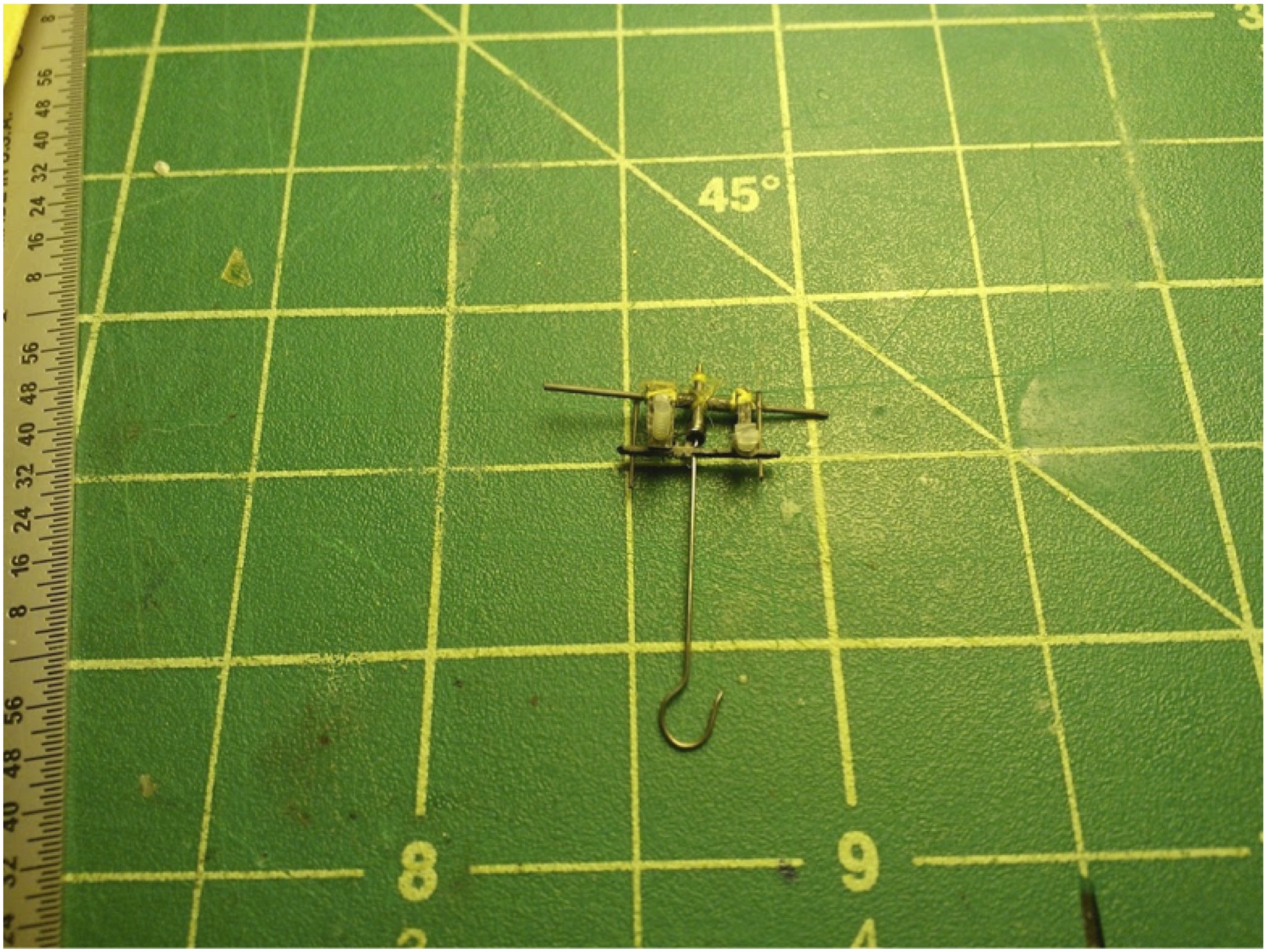
Front side of the hub. Here, a spring wound using a .031” mandrel is shown. The spring doesn’t seat well over the .028” OD carbon tube “shaft sleeve”.
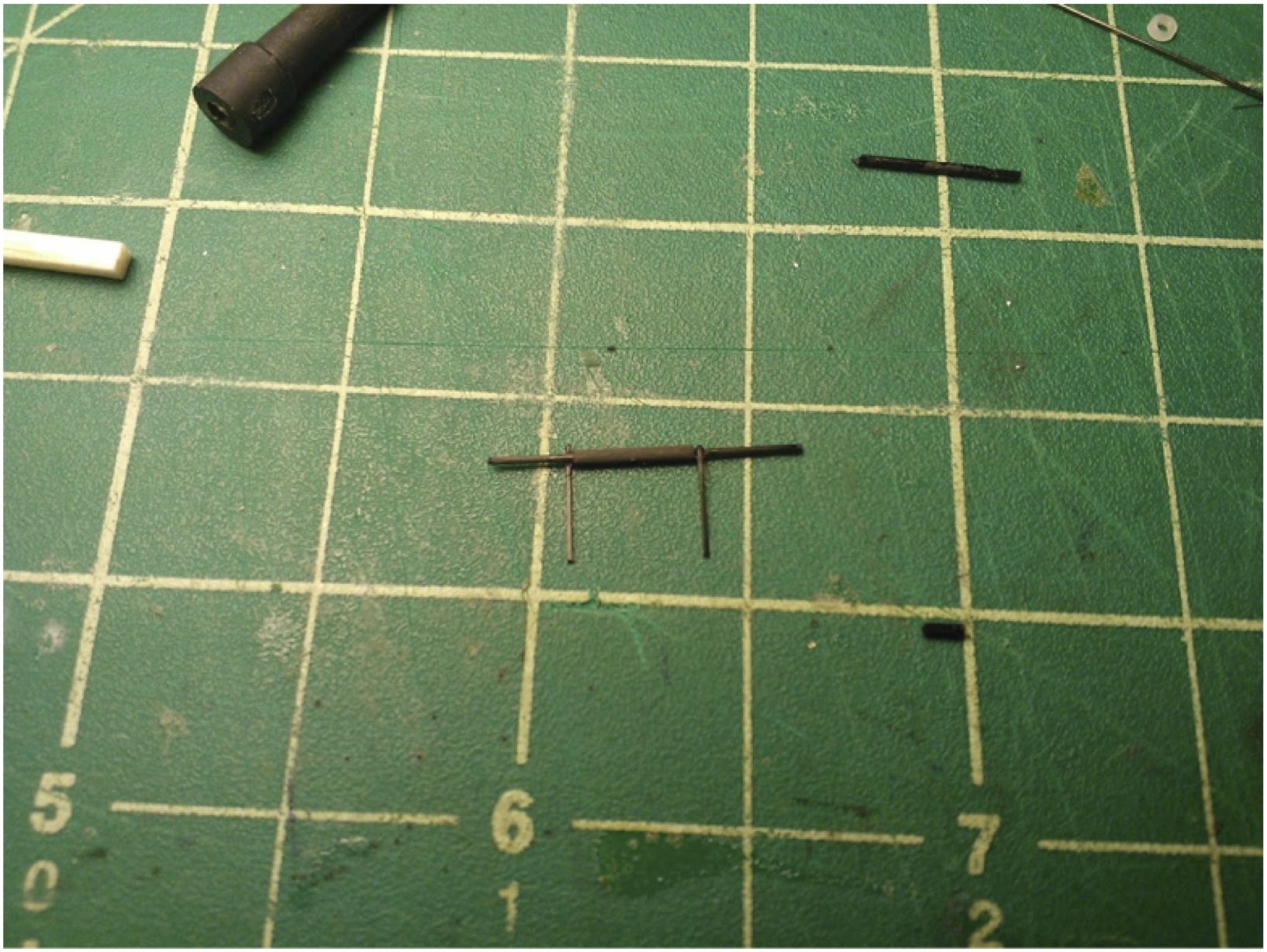
Carbon tube “hub” before prop shaft sleeve hole is drilled. The lever arm is glued to the spar “rod” using thin CA. Only tack gluing is needed. The lever arm is later securely glued to the end of the prop spar.


Please click here if you would like do download a PDF of Kang Lee’s CAD drawings
Ben Saks’ Float Is In Postproduction
The article below is copied from an update that went out to their backers on February 7th.
“We appreciate all of your continued support, and apologize for the long time we have taken to post this update. There has been a lot of speculation about what’s going on with Float. We hope this update will answer your questions.
KIT STATUS and BACKER REWARDS: Kits will start shipping in March, with the Ministick and Penny Plane Kits shipping first, followed by the F1D Kits. We will also be posting the video tutorials in March. These videos will be instructables focusing on how to properly build, trim and fly the planes. Please look for emails and messages asking for your shipping address. I will be sending these requests out in the next week. The non Kit rewards will be mailed or available upon the completion of the film.
FILM STATUS: After the successful completion of our fundraising efforts we carried out the final production tasks needed to complete the filming of Float. Our production team travelled from New York to England, Japan, Romania and Serbia in July and August 2012 to film on location and to cover the World Championships of F1D.
We have now collected over 8 terabytes of footage over the course of three years. This amount of footage is not easy to work with, however we have captured many great moments. Filmed on location in Argentina, England, Japan, Serbia and Romania, Float will truly represent the international competition of F1D. We interviewed many of the most important individuals in the hobby, and captured the entire 2 year F1D World Championship cycle from start to finish.
Despite out best efforts we are unable to release the film as scheduled in February 2013, however we are on schedule to submit the film to festivals in September of 2013. We are working with a post production company to assist in the remaining professional services needed. This includes editing, sound design and music supervision, and voice-over narration.We will post continual updates about the status of the film throughout this post-production process. We will also be posting an updated trailer for the documentary. All of our efforts will focus on completing and releasing the film in 2013.
We honestly appreciate all of your continued support, and apologize for the long time we have taken to update our backers. Float is a passion project for us. We have come this far and are very close to getting this project finished. However we also have other real-life responsibilities which could not take a back seat over the last few months. With that being said, we are pushing full-steam-ahead to complete Float!
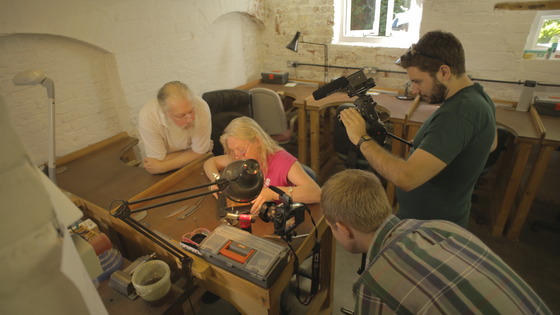
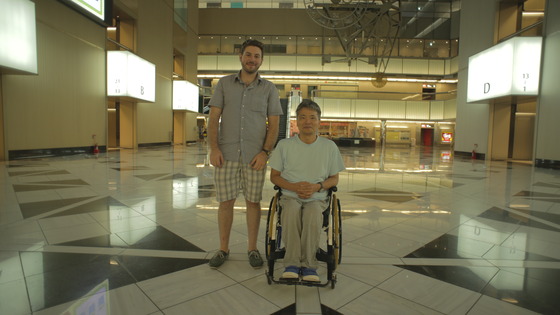
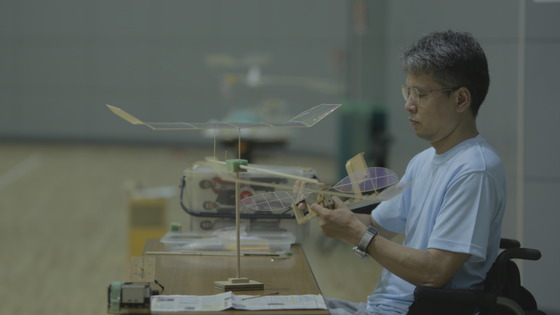
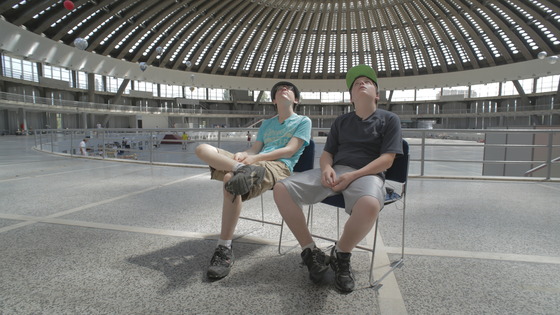
Here are some photos from our journey. This is just a taste of things to come!”




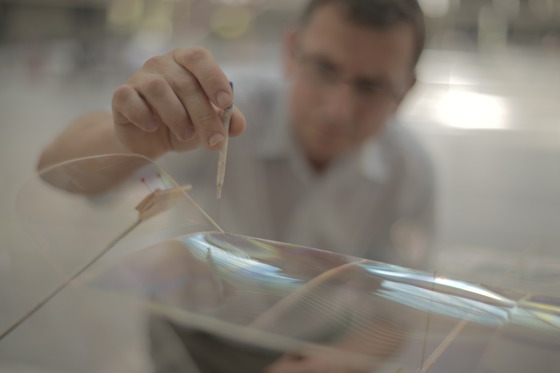

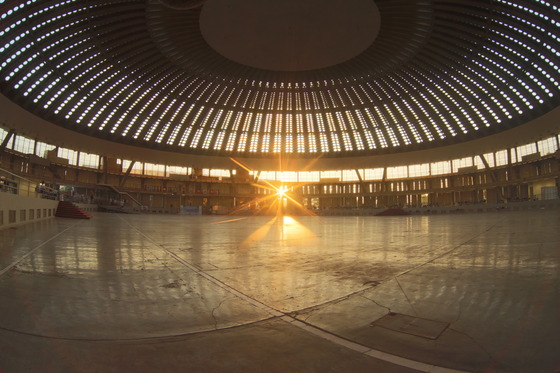
Ever since I started to use the Trumeter 7111 counter in the Chain Gang Winders, I’ve been bothered by the fact that the battery wasn’t replaceable. Using a new $40 counter every 8 or 10 years isn’t a problem in an industrial application, but this is a hobby. It’s not a problem for me personally, as I’m 77 now, and what are my chances of outlasting the battery? But for young kids like Finn and Kang, it’s a repetitive expense that isn’t fair. Even worse, the most recent customer is only 13, and given a normal lifespan, and if she stays in the hobby, she’s looking at an expense of better (worse?) than $250 over the years. This is unacceptable.

.015 x .250 from the K&S rack at the LHS. 6″ lengths of servo wire, either Dubro as shown or Futaba, or whatever you have.
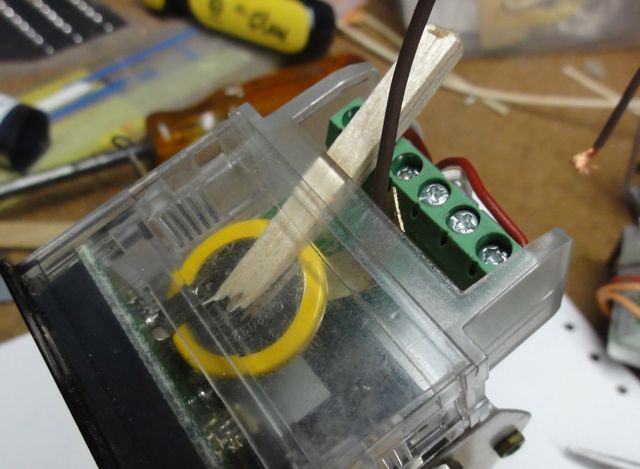
Butter the bottom of the neg. strip with epoxy and feed it down under the cell using small nose pliers. Locate it along the diagonal edge of the PC board. Then slip a balsa wedge over the top of the cell to hold things together while the epoxy sets.
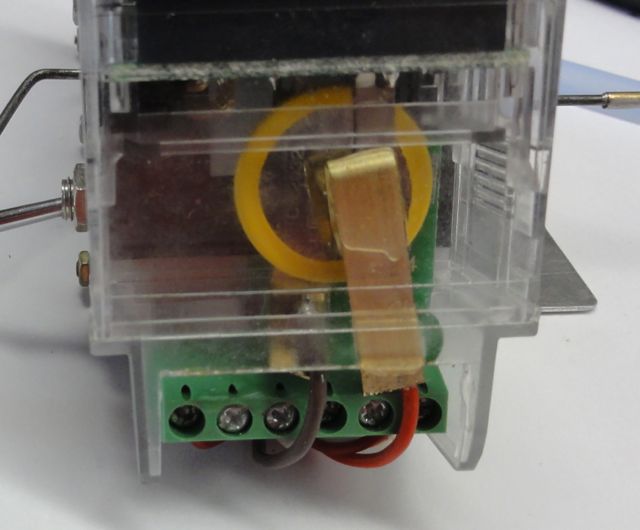
Smear epoxy on top of the positive strip and slip it into place as shown.
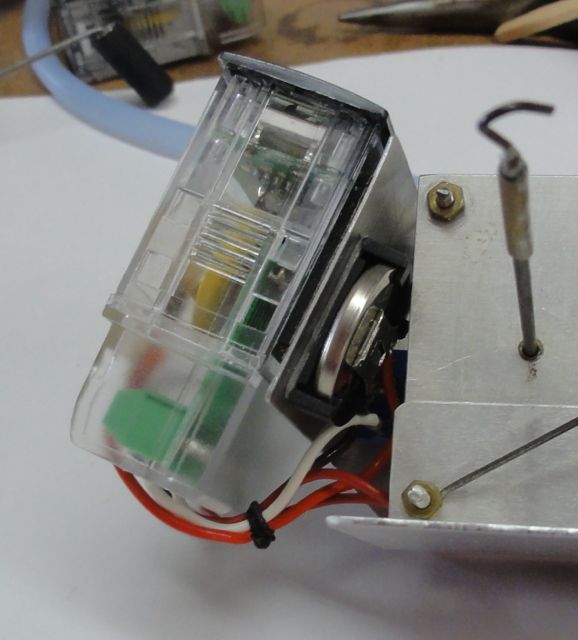
Secure a CR2032 cell holder to the back of the aluminum bracket with 2-face tape and solder the leads on neatly. Sometime around 2020-2022 the original battery will die.
Folding F1D Wing tips
Whether you want to take along an extra wing or there is some question about your model box fitting into the overhead compartment of an airliner, here is a way to travel with a much shorter box. The wing tips are folded over so each wing will fit into a slot or box .7X8.5X15” or shorter depending on the length of the center panel. To use this system the dihedral joints are overlapped and it will be necessary to adjust the chord at those joints to comply with the 20 CM chord rule.
After the wing tips have been unfolded, the wing can be stored in one of those cardboard under the bed boxes. The box lies flat when disassembled and can easy be placed in with clothing or support gear and reassembled in a few minutes
When building the wing, overlap each tip spar at the dihedral joint (.075”) and glue it to the main spar with Aliphatic (carpenters glue) and glue the ribs in with Acetate glue. There’s no reason to worry about the film or rib coming loose near the dihedral breaks when using Aliphatic to glue the dihedral joints. After the wing is removed from the building board, make up four wire hinges using short pieces of .005 music wire bend at ninety degrees. (Four hinges weigh less than .006 g) Make a piercing tool using a .4” long piece of .005” music wire mounted in a small dowel and it’s best to sharpen the piercing end. Back up the spar with a pair of tweezers or hold the dihedral rib with your fingers. Take the tool and pierce a hole in the center of the joint and rotate the tool while pushing it through the spar, glue joint and into the dihedral rib. Insert the hinge and line up the end so that it is parallel with the spar.
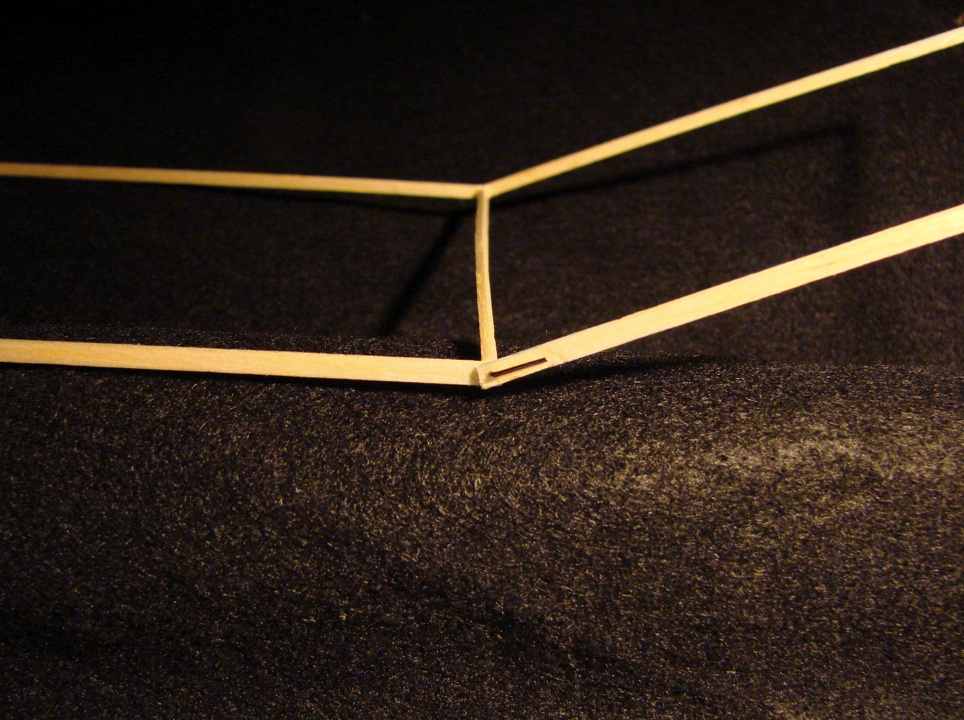
.005mw hinge to prevent wing tip from separating from main spar
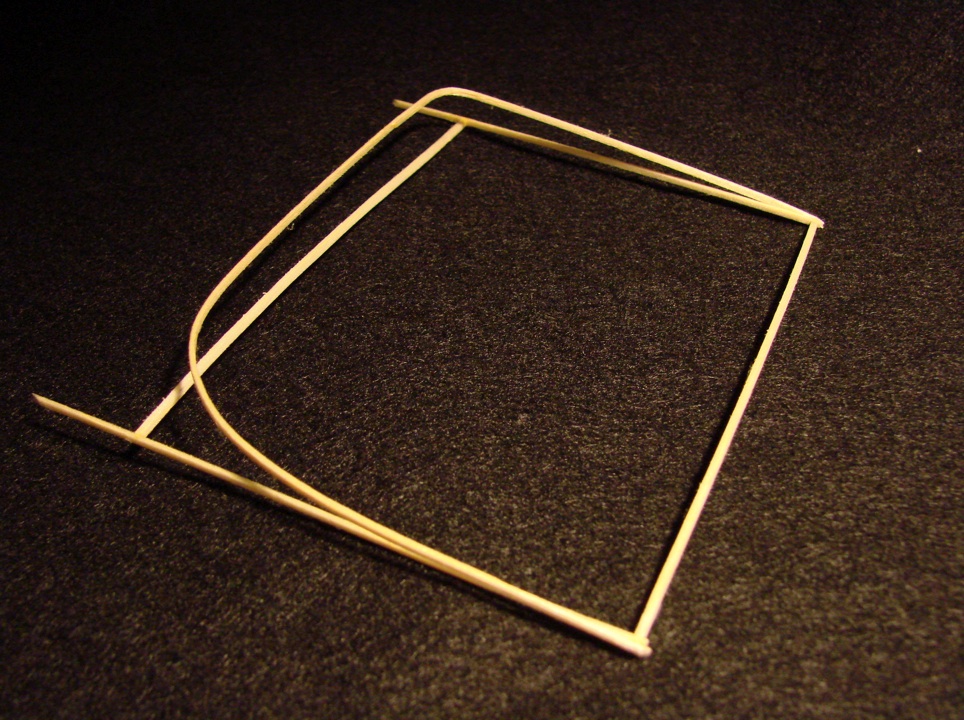
Wing tip in the folded position
After the wing is covered, lay out a small piece of plastic or waxed paper under each dihedral joint. Lay a small weight on the spars near the inside of each dihedral rib and one right in front of each dihedral joint and puddle two drops of water under each joint. Lift up each tip about 1/2” with a piece of balsa so that the tip outline will bow near the dihedral break. It will take several minutes for the glue to soften and it might be necessary to place a little extra water on the joints, but don’t flood them. Slowly lift the tip a little more to place added pressure to each joint. The tip outline could break at the dihedral joint if you get in a hurry. The glue will usually let go all at once and the wing tip can be folded over on the center panel. Leave the small weights in front of each dihedral joint until the aliphatic glue hardens to make sure the joint doesn’t open when the tips are folded over joint. The wire is placed at each joint to prevent this from happening but I leave them in place for added security. Place a little extra Aliphatic glue at each dihedral joint. Reverse the procedure to fold the wing back to its original length.
L Coslick
Lutz Schramm’s World Championship F1D
Only two models posted times in excess of 36 minutes at the 2008 F1D World Championships in Belgrade, Serbia. The champion Ivan Treger and second place finisher, Lutz Schramm. Ivan’s model was a traditional design built to exacting standards with a refined prop hub while Lutz’s model displayed a new level of integration of composite materials. How close was the composite model to the champion? The difference was 29 seconds out of 71 minutes, 0.68%. 
John Kagan, who nominated the model, reported that Lutz’s model was the talk of the contest with its innovative use of advanced materials.
Lutz says, “the special technical highlights are: Wing post from Carbon tube; all ribs from Boron Balsa Boron layers also the propellers ribs. Rudder Outline from CFK; Propeller Outline from CFK. The propeller is without Propeller spar.”

The mini-spar prop with its carbon outline shows clearly in this photo.

The prop hub and carbon wing posts along with the model’s elliptical dihedral set it apart from the competition.
Please follow the link to download a PDF of Lutz Schramm’s Plan with the 2012 Propeller Design.


Please follow the link to download a PDF of the Wood Sizes.
Many of the top fliers in F1D are using carbon outline props. One of the drawbacks to using carbon is the sanding required to get down to weight. This is what drew me to towards boron-capped prop outlines.
For this example, I used standard 0.025″ 5# balsa cut into squares. I like using several reference marks to keep the grain straight and ensure that there is no twist introduced. Because many of the steps are the same as building a standard built-up prop, not every step is illustrated.
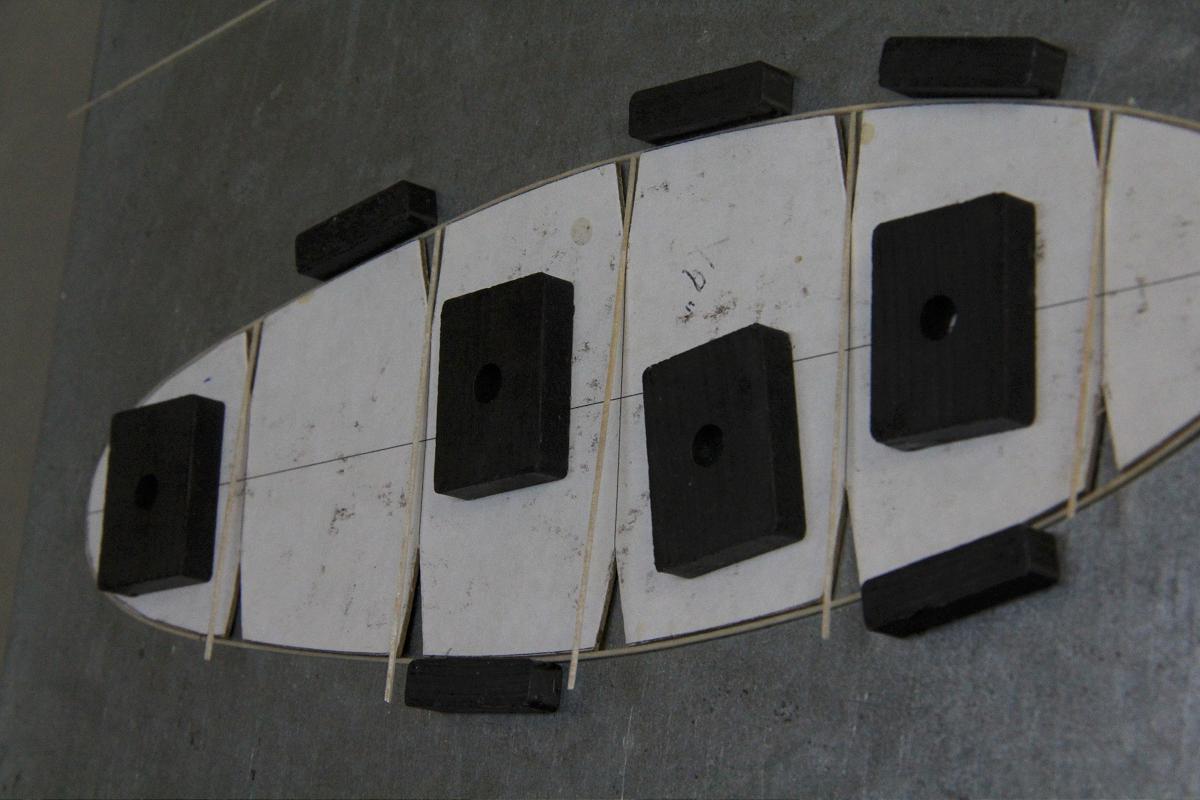
Prop outline with flat ribs attached
I build on a piece of steel with magnets. The larger ones hold down the forms, the smaller ones are used to keep the balsa in place. Here instead of using sliced ribs, I used flat pieces. First, I glued all the ribs to one side of the outline.

Outline with all flat ribs attached
Here, all of the ribs are glued down. The ends are left loose and trimmed.
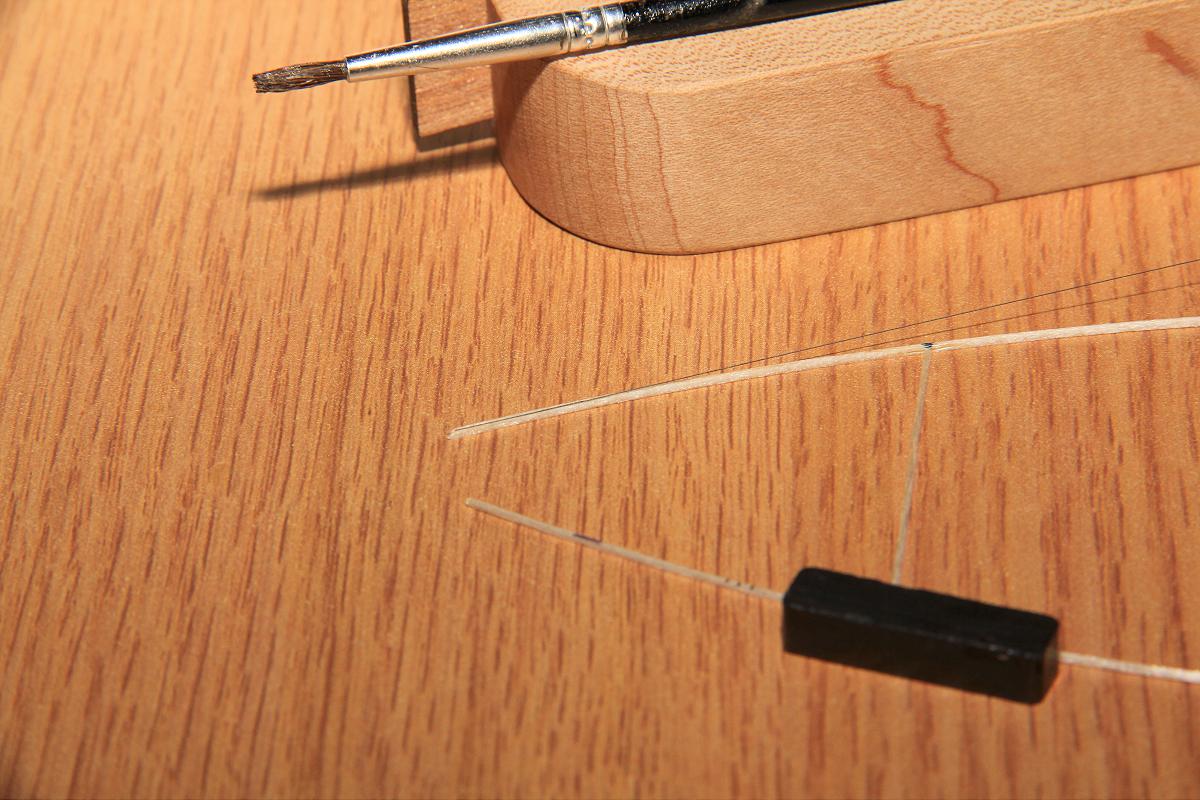
Attaching boron
Next, the boron is attached here with a brush dipped in acetone. A bit of thinned Ambroid could also be used to ensure attachment at the end.

Attaching boron #2
I use my fingers to align the boron and hold it down. Then I brush on more acetone to attach the boron. The brush should be pretty ‘wet’. Just be careful around the rib glue joints. It may be useful to mark the rib joints in case they come loose.
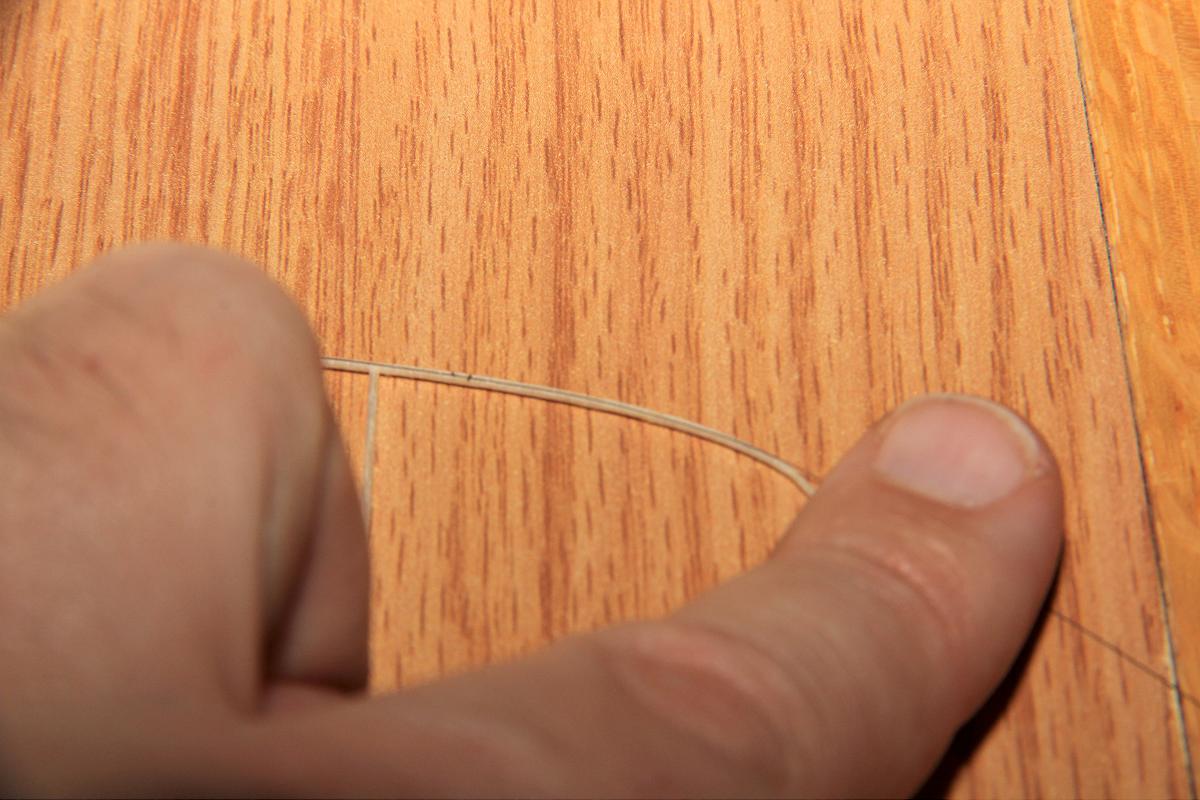
Attaching boron #3
Once you get down to the tip, work in smaller sections. Thinned Ambroid can also be useful here at times. Keep working in small increments, just 1/4″ at a time or so.

Around the tip
I try to keep the boron as centered as possible – Keep working in small sections here.

As the radius gets smaller…
It becomes easier again and you can do an inch or two section at a time.

Capping the ribs
I’ve used 004 boron for the inner two ribs here as the spar will not go to the end. Not sure it is necessary. I have the boron slightly overlap the glue joint to give some extra strength. Thinned Ambroid helps here occasionally. An Xacto blade can be used to ‘break’ the boron at a particular place – just bend the boron against the blade until it snaps. I don’t tend to get fragments this way, but if they do occur the glue on the boron typically holds them in place.
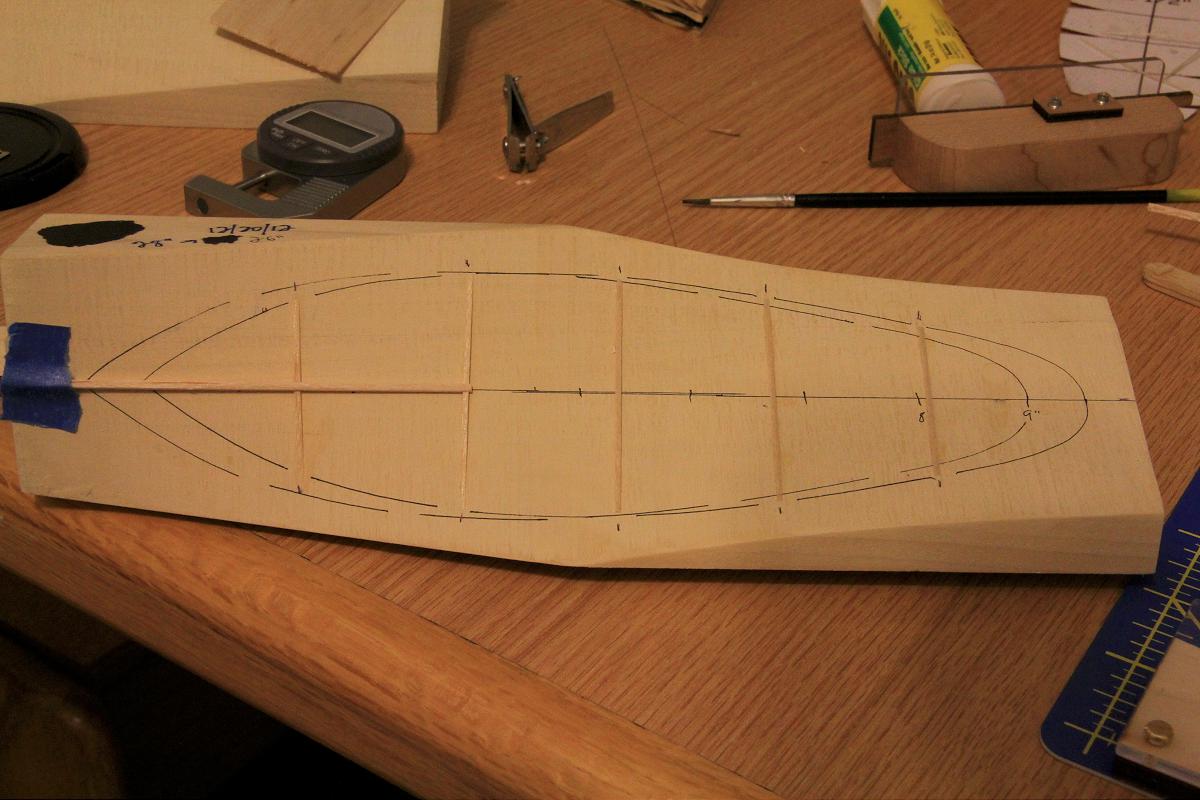
Preparing the prop block
Pictured here is a prop block I cut on my fixture. I have marked both the outline and the rib locations and cut out some 3% arc sections, gluing them to the block with thinned Ambroid. On the inner two ribs I cut a bit out to hold the spar in place. The spar stands slightly proud here, so 5% might be better here.
Not pictured – The entire outline is placed in a tray of water and soaked for several minutes. It comes out all bent as the balsa expands.
HINT: It might be wise to use some wax or Scotch tape on the line of the outline before this next step.
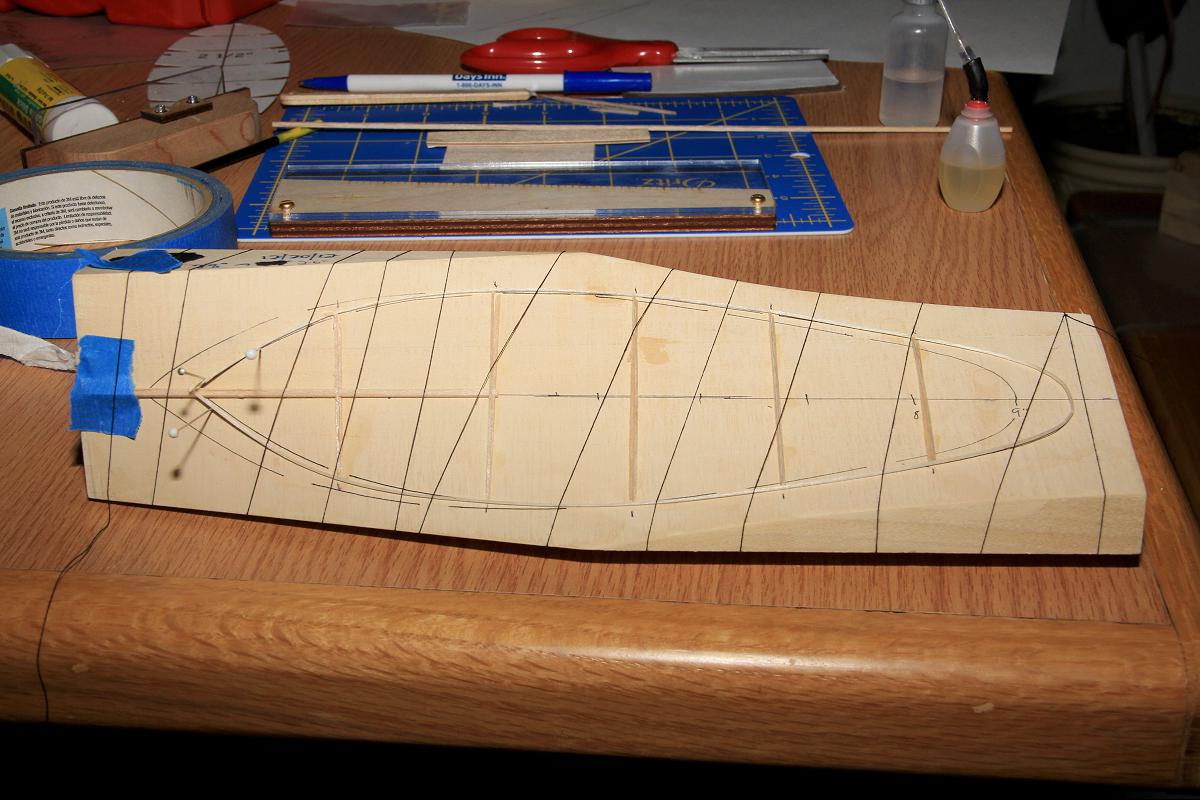
Thread wrapped wet outline
Place boron side down, adjust to the line and wrap with thread. If there appears to be any lifting off the block, add bits of tape to the thread right next to the outline to keep it tight. Secure the end with tape. I like to use thin silk pins, because they press pretty easily into the Poplar block. You typically just need them near the spar/outline joint. Let dry thoroughly – best not to use heat (oven) here.

Slice ends of outline off
This one is not as in focus as I would like but a bit of boron is sticking out past the angled slice. Insert the boron into the spar wood being careful to align the top of the outline with the top of the spar. This is one of the most fiddly bits. Glue it up well and let dry.
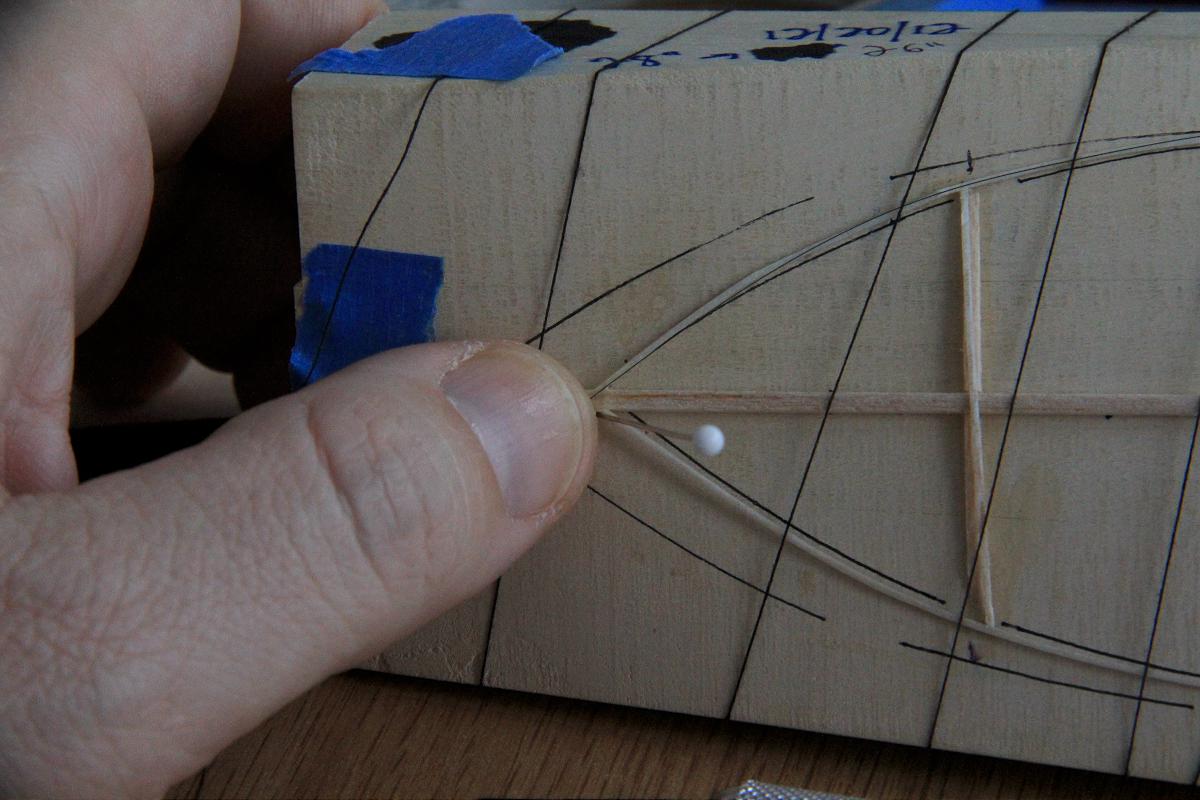
Attaching boron on top
Now we have to repeat the process attaching the boron on the top side. First, slide the boron underneath all the threads at the top. Bend it down so it approximates the arc of the outline and glue well here. It will overlap the spar/outline joint. Use thinned Ambroid if necessary to glue it down here.
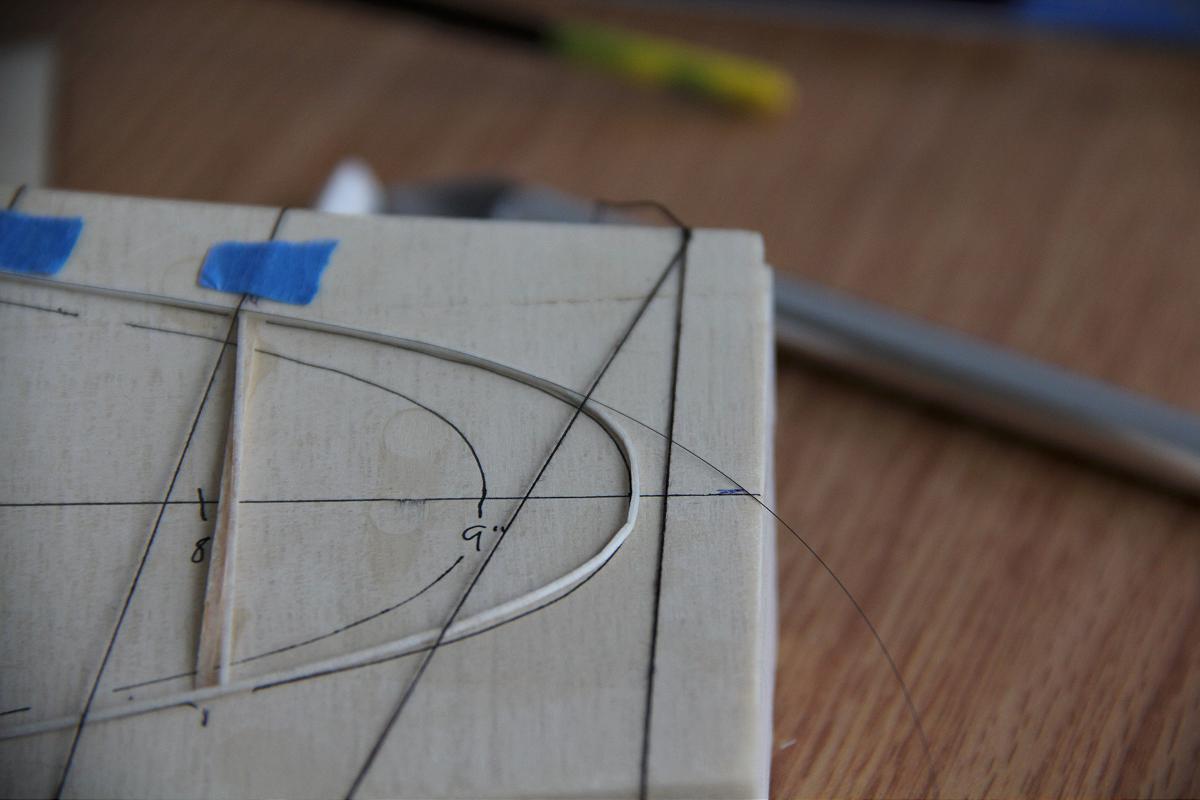
At the tip
The rest is amazing similar to doing the bottom side. Brush on acetone while holding the boron in place. When you get close to the tip, loop the boron around underneath the lower threads.
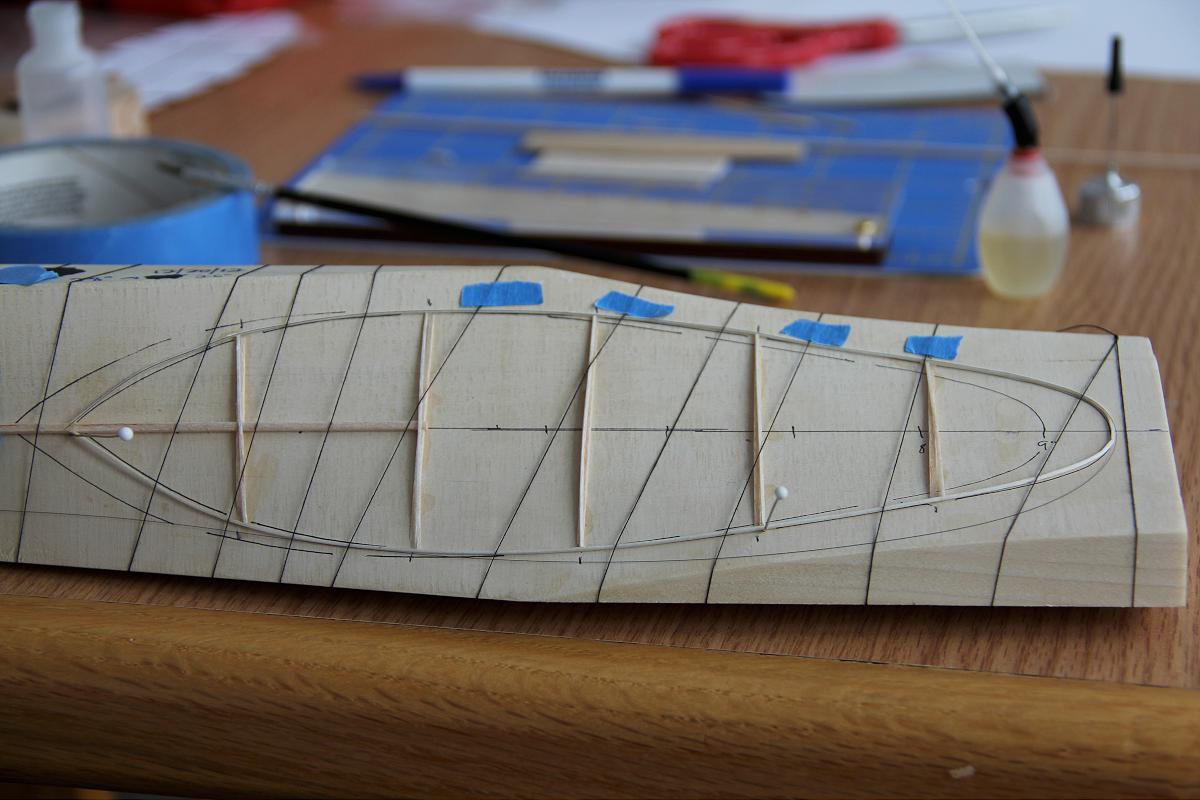
Starting on the bottom
Pictured above, is the outline with boron looped underneath and ready to begin gluing.
I omitted taking pictures capping the ribs. I found it best to start at the top with some thinned Ambroid, let dry thoroughly, then bend the boron to the rib outline and use the brush dipped in acetone to attach it.
Be careful when separating the outline from the block. A thin razor blade can be useful if you happened to accidentally glue it to the block.
At this point the blade can be covered normally. I have not had any problems with the boron popping loose to date. If it does occur, a bit of acetone should reactivate the glue – or it could be glued down with very thin Ambroid.
I suspect that the 5# 0.025″ is too heavy in this application. I would try some 4# 0.020″ wide (keeping the distance between boron at 0.025″) to lighten the outline. I assume the ribs could also be done somewhat differently to shave some weight.
Two last points: All boron was 003 except for the top/bottom of the two innermost ribs. I cleaned the boron with paper towels dipped in acetone first, then used one of Ray Harlan’s glue pots to apply the glue ahead of time. I will typically do 10 or so boron this way and leave them taped up to the wall until needed.
Source: http://www.indoorspecialties.com/contents/en-us/d40.html

Ray’s glue pot filled with Ambroid
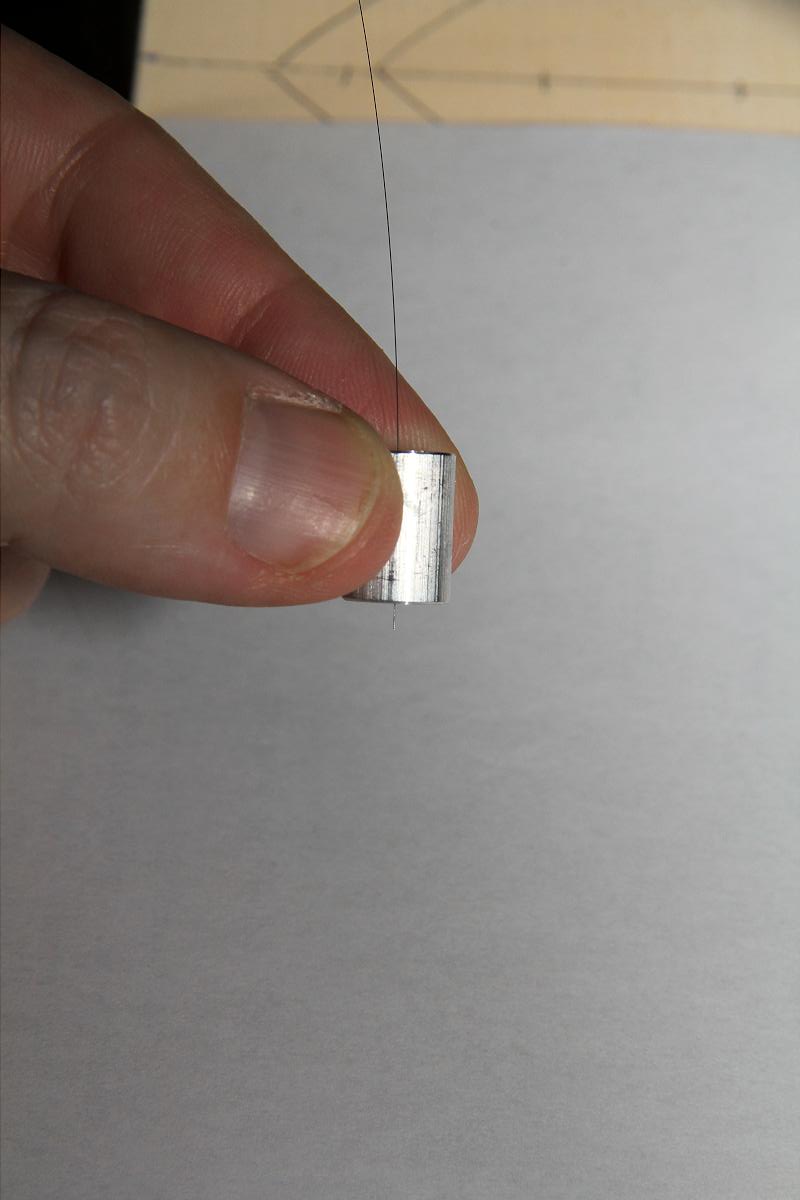
Boron inserted into glue, sticking out the bottom hole.
Take good care of the glue pot, soak in acetone when needed. A 0.013″ wire will help keep it clean.
Hoping you find this helpful!
Mike Kirda
View more by category: Uncategorized (292). .



 Indoor News and Views